The mistake
More hours of practice does not equal more progress. Pianists who practise on the wrong physical frame can repeat a passage a hundred times — and encode the wrong pattern more deeply each round.

Nothing to do with finding more pieces to practise — and nothing to do with practising harder. Everything to do with the instruction behind how you play the ones you already have.
You can spend a lot of time at the piano without much to show for it. That is rarely a discipline problem — and almost never a talent problem. It is an instruction problem, and it is almost invisible from the inside.
More hours of practice does not equal more progress. Pianists who practise on the wrong physical frame can repeat a passage a hundred times — and encode the wrong pattern more deeply each round.
Years of effort can pass without compounding. Tension builds, speed limits hold, tone stays uneven — not because the pianist isn't working, but because the work is shaped around the wrong thing.
Sound-shaped, mechanism-based teaching. The arm, wrist, and hand learning to coordinate around what the music actually asks for — so the hours you already practise start to compound.
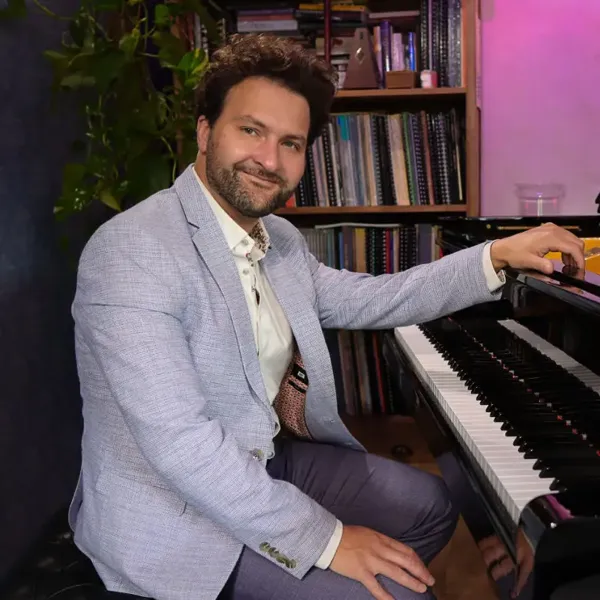
I've been teaching piano for over twenty-five years — in the Netherlands and in China.
Conservatory-trained, rooted in the Rubinstein tradition, and still — after all this time — the thing that gets me to the piano every morning is sound.
How it's made. Why it carries. Why one pianist can play the same notes as another and leave a different kind of silence afterwards.
That is what I teach. Not shortcuts. Not tricks. The patient, specific work of building a technique that serves the music — so that what you hear in your head can actually reach the room.
That work has a shape. It is what the next section is about.
You've played for years — sometimes decades — and you've never quite felt you understood why one passage works and another doesn't. You want the mechanism, not the memorization.
You've hit a wall. Tension, speed limits, uneven tone — and the suspicion that working harder isn't going to fix it.
You played years ago and want to come back — this time with better habits and a clearer sense of what your hands are actually doing.
If you want to play a piece for a wedding next month, this is the wrong place. The membership is small on purpose — twenty or so serious pianists, working slowly. The work compounds. It doesn't shortcut.
If you have practised for years without the progress you expected, the reason is almost never effort. It is instruction.
Most piano teaching treats technique and music as two stages — first you drill the mechanics, then, eventually, you make something musical out of them. Piano Fantasy does not separate them.
The technique work here is shaped by the sound you are trying to make. The sound work is grounded in how the hand, arm, and ear are actually coordinating.
That is the transfer the method trains — from a clear Musical Intention, through Prepared Coordinated Movement, into the Sound you meant to make. Everything on the site sits inside that loop.
The technical work is shaped by what you are trying to hear.
Every note has a physical moment that precedes it.
Arm, wrist, and fingers working together — not drilled apart.
Piano Fantasy Pro is where the instruction gap closes — deliberately, with a teacher who can see your specific situation and a small community working at the same depth.
Courses, live lessons, written feedback on what you're actually practising. The membership is small on purpose — around twenty serious pianists. The price is honest. The work compounds.
Try the first technique. Do the first exercise. If you don't feel the shift in how your hand sits at the keyboard, full refund — 30 days on the annual plan, 15 on monthly.
“Amazing teacher. Due to Lars' method of arm and finger technique, my piano play has improved a lot. He goes into great depth and that gives me a lot of joy in playing the piano.”

“I have learned with Lars how to solve technical problems. I also became better at my rhythm and improvisation. Lars is really an excellent pianist and also a very good teacher.”
“This program has given me renewed interest in approaching my piano and long loved pieces. I now play with new enthusiasm into my super fingers.”

Piano Fantasy is a piano-teaching platform built for serious adult pianists — the ones who care how they play, not just what they play. The teaching focuses on the mechanism layer: how the arm, wrist, and hand actually produce the sound you want.
It is run by Lars Nelissen — twenty-five years of teaching, conservatory-trained in the Rubinstein tradition, working with adult pianists from beginner-returners to advanced.
Against private lessons: a fraction of the cost, and faster feedback when you actually need it. A year of weekly private lessons typically runs around $4,000 — roughly $100 an hour, forty weeks. And when you hit a wall mid-week — a fingering that won't work, a passage that resists — you don't wait seven days for the next lesson. You post in the community, upload a short video showing what's happening, and get an answer within a day — from me or from other pianists who've been through the same wall.
Against other online piano courses: most are courses only. No live interaction, no personal time with the teacher, no path to ask the question that's actually blocking you. The Pro Membership includes both — the structured course material and the weekly contact. And on the teaching itself — few methods actually teach a complete piano technique the way the Super Fingers method does. It is the approach the great teachers have always used: how the arm, wrist, and hand coordinate to produce sound, taught as a complete system rather than piece-by-piece tips.
No, it doesn't have to. Piano Fantasy can sit alongside in-person lessons very comfortably — as long as your teacher is open to it.
That said, Piano Fantasy is designed to be used without a separate teacher too. So whether you have one or not, the teaching works.
Yes — any time, from your account page. Try the first technique, do the first exercise, and if you don't feel the shift in how your hand sits at the keyboard: full refund, 30 days on the annual plan, 15 days on monthly.
After that window, cancellation cadence depends on the plan you chose at signup. You can cancel at any point and the membership simply ends at the close of the current billing period. No retention call, no friction.
Yes — beginners join and do well here, and it can genuinely be a good time to start, since good technique and habits are easier to build from day one than to fix later.
The one real condition: you should already be a little familiar with reading notes and able to work through a simple piece from a score on your own. Learning to read music from the very beginning isn't something this program teaches — the courses pick up one step after that.
If you're not sure where that leaves you, the reading ladder (opens in a new tab) gives you concrete ways to check, including a short score you can try in about a minute.
Yes — and most of what's worth reading is on the blog. That's where the longer pieces live: technique walk-throughs, repertoire notes, the kind of writing that takes more than a minute. There's also a little bit on YouTube, and the Piano Fantasy Minute newsletter — twice a week in your inbox, free, no upsell inside the emails themselves.
What the free path can't give you is structure. The blog is browse-it-when-you-want; the newsletter arrives in pieces. The Pro Membership is the same teaching laid out in a coherent order, with the exercises you actually do, the live lessons where you can ask the question that's blocking you, and personal guidance when you get stuck. The free content is real — it isn't a sample. The Pro Membership is a different shape of teaching, not a more-of-the-same upgrade.
Recent writing on technique, sound, and the work itself.
How to interpret a piano piece: build a sound picture early. Where good recordings exist, listen to the great pianists for a direction. In the score, read what the composer wants and count the rhythm exactly. Then search at the piano, phrase by phrase.
Read More →
How to apply piano technique to pieces: skills practised one by one don't come together by themselves. Take one phrase and ask one question each time through: where the phrase starts and ends, the tension toward its gravity point, the balance between the hands.
Read More →
How to play octaves on piano without tension: when the wrist locks to hold the stretch, the hand tires and the sound turns flat and heavy. Feel the stretch inside the lower arm, keep the wrist level and free, and work a page of octaves in divisions, relaxing your muscles for a split second between them without losing the shape of your hand.
Read More →