
In healthy piano movement, the arm initiates and the wrist responds
The movement begins in the forearm.
The wrist remains free so it can follow that arm motion without resistance.
When the wrist starts flapping, lifting, or circling on its own, clarity and power decrease.
Not because the wrist is “working,” but because it is trying to lead a motion that belongs to the arm.
When the wrist blocks or locks, the arm cannot move freely at all.
A good wrist is free, flexible, and responsive.
It moves because the arm moves — never as an independent driver.
Even in octaves, scales, or wider motions, the wrist does not initiate.
It allows the forearm to lead.
Try this
Play a small two-note pattern.
- Drop the arm into the first note.
- With a fluent forearm movement, raise the arm into the second note as preparation.
- At the highest point, part of the weight is already released from the second note.
- From there, drop again into the first note of the next group.
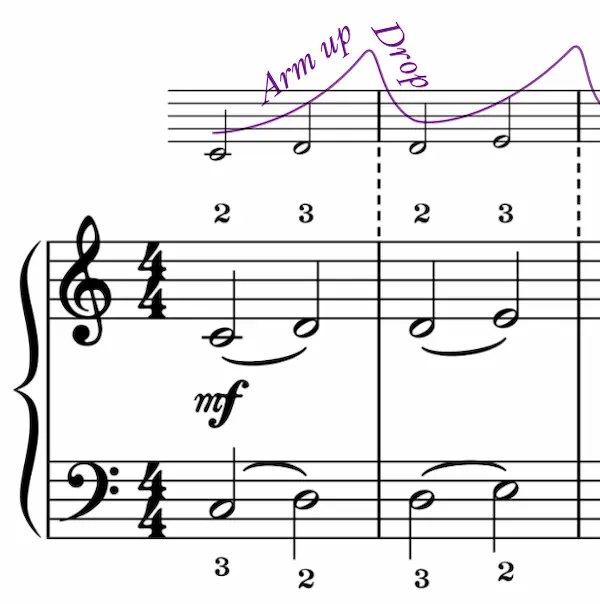
Let the wrist follow this movement freely — without blocking and without taking over.
The catch
A free wrist is good.
A collapsing or stiff wrist is not.
The wrist should follow.
It should neither resist the arm nor replace it.
Summary
The arm leads the motion.
The wrist follows freely.
The fingers remain concentrated and finish the sound.
This coordination is central to healthy piano technique, whether in scales, octaves, or broken chords.
These elements form part of a larger coordinated system, explored further in Piano Fantasy Minute #014 – Piano Technique as a Coordinated System: How Arm, Wrist, and Fingers Work Together.
Where this appears
This principle runs through the entire Super Fingers method, with special focus in Exercises 6, 11, and 14.
If your wrist feels uncertain or uncontrolled, post a short clip inside the Piano Fantasy Community. We’ll help you find a free wrist that follows the arm — while keeping the fingers concentrated.