You can play a phrase with every note correct, every finger in place, the notes connected cleanly from the first to the last — and the line still goes nowhere.
The notes lack direction. Nothing flows, nothing arrives — it is a row of well-played notes, and a row of well-played notes is not yet a phrase.
What is missing is the gravity point of a phrase: the point the whole line is pulling toward. This is a core of musical phrasing — not the whole of it, but the mechanism most often missing when correct notes refuse to become a line. Once you hear a phrase this way, it is hard to un-hear — so let me start there and build it out.
A row of correct notes that goes nowhere
This is one of the most common things I hear, and it is not necessarily a problem with the notes. The notes are fine, the fingering works, the rhythm holds, the legato is smooth.
And yet each note arrives carrying the same weight as the one before it. The ear has nothing to group and nothing to follow. The line just runs.
There is no pulling — no tension between the notes. They are all equal, and equal notes do not make a shape. What makes a phrase sound musical here is not another note, and not more dynamics. It is a point the notes are organised around.
Musical phrasing: every phrase is already going somewhere
Here is the part that changes how you practise. A phrase has a direction before a single note sounds — it is already moving toward something. A peak, a cadence, a point of arrival.
I have written elsewhere that a scale needs a direction, a sense that the hand knows where it is going. This is the other half of that idea: direction is the sense of going somewhere — and the gravity point is what the direction is pointing at.
The gravity point is the point a phrase pulls toward. The word carries the mechanism: it pulls. The notes leading in are drawn toward it — and if the phrase continues past it, the notes after ease away from it. That is the whole idea, and it is exactly what was missing from the row of correct notes.
Often one note, often a small group
It is tempting to think of the gravity point as a single note — and quite often it is one note, the one place everything leans toward.
At other times it is a small group — two or three, maybe four notes. Five is already a lot, and you mostly see that in quicker passages. So the honest way to hold it:
- Often one note — a single, clear point of arrival.
- Often a small group — two or three, maybe four — leaned toward together.
- Both are common. Neither is the default.
This matters because hunting for a single high note can send you looking for a peak that may not even be the highest note in the line. The gravity point is not defined by register — it can be a low arrival, a cadence, a point of harmonic arrival, anywhere the line is genuinely heading. What makes it the gravity point is that the other notes pull toward it, not that it sits at the top.
The two pulls that make the arc
The arc of a phrase is not something you add on top of correct notes. It is produced by two pulls — toward the gravity point, then away from it.
Take the gravity point out, and you remove the reason the notes are unequal — you are back to the row of well-played notes. Put it in, and the same notes start to gather and release.
Pull toward: the approach leans in
The notes before the gravity point lean toward it. They are not neutral, evenly matched, interchangeable notes — each one is already on its way somewhere. That is what gives the approach its sense of going.
How that leaning is carried varies, and this is where players reach too quickly for one tool. Sometimes it's a little arm weight settling into the arrival. Other times it is pressure — a touch more into the keys — or nothing of weight or pressure at all: just a little momentum in the tempo, a touch of rubato.
The directional idea is the constant; which means carries it is a judgment for the specific line.
Once you know which note the phrase pulls toward, the next question is what the time does on the way there — a little give before it, or a little push into it. That is a different decision from finding the note, and I wrote it out in how to play rubato on piano.
And this is the part to feel clearly: that pulling, that tension between the notes, is the result of the gravity point. It is almost like an elastic you stretch a little, then let go and relax. The stretch is the approach leaning in; the release is what comes next.
Pull away: the release, and what it can feel like
If the phrase continues past the gravity point, the closing notes pull away from it — the energy that gathered into the arrival now disperses. Use pull away or ease away for this, not resolve. Resolution is a harmonic event, and a phrase can pull away from a gravity point sitting on a harmony that does not resolve at all.
What the pull-away feels like is not fixed, and this is worth holding open. Depending on the music, the closing notes can settle and come to rest where the harmony genuinely resolves. Or they can fall away and let go — the line releasing its hold. Other times they stay pulled outward — the phrase ending while the pull is still felt, never quite settling.
All three are possible. Which one is right is a musical judgment for that passage, not a rule — none of them is the default.
One thing to keep distinct here. This pull-away is directional — it is about where the energy goes. It is not the same as the phrase breath — a release of arm tension, which is a physical letting-go that often lands at or just after the gravity point.
The two frequently coincide — but they are not the same thing. This post is about the direction the line is travelling; that one is about the physical release.
Mark it on the page
There is a concrete way to make this real, and it is how I was taught. My own teacher wrote the gravity point straight into the score — marked it on the page, so the whole phrase visibly organised around it. I teach it the same way.
Before you practise the phrase, find where it is going and write it in. Mark the note — or the small group — that the phrase pulls toward.
Here is what that actually looks like in my own score. This is from my copy of Chopin's Nocturne in F♯ minor, Op. 48 No. 2 — the Molto più lento middle section, one of the first pieces I studied when I came to work with Avi Schönfeld. The hooks drawn over the noteheads, each covering two or three notes, are the gravity points marked in; the little arrows point back toward where each phrase begins.
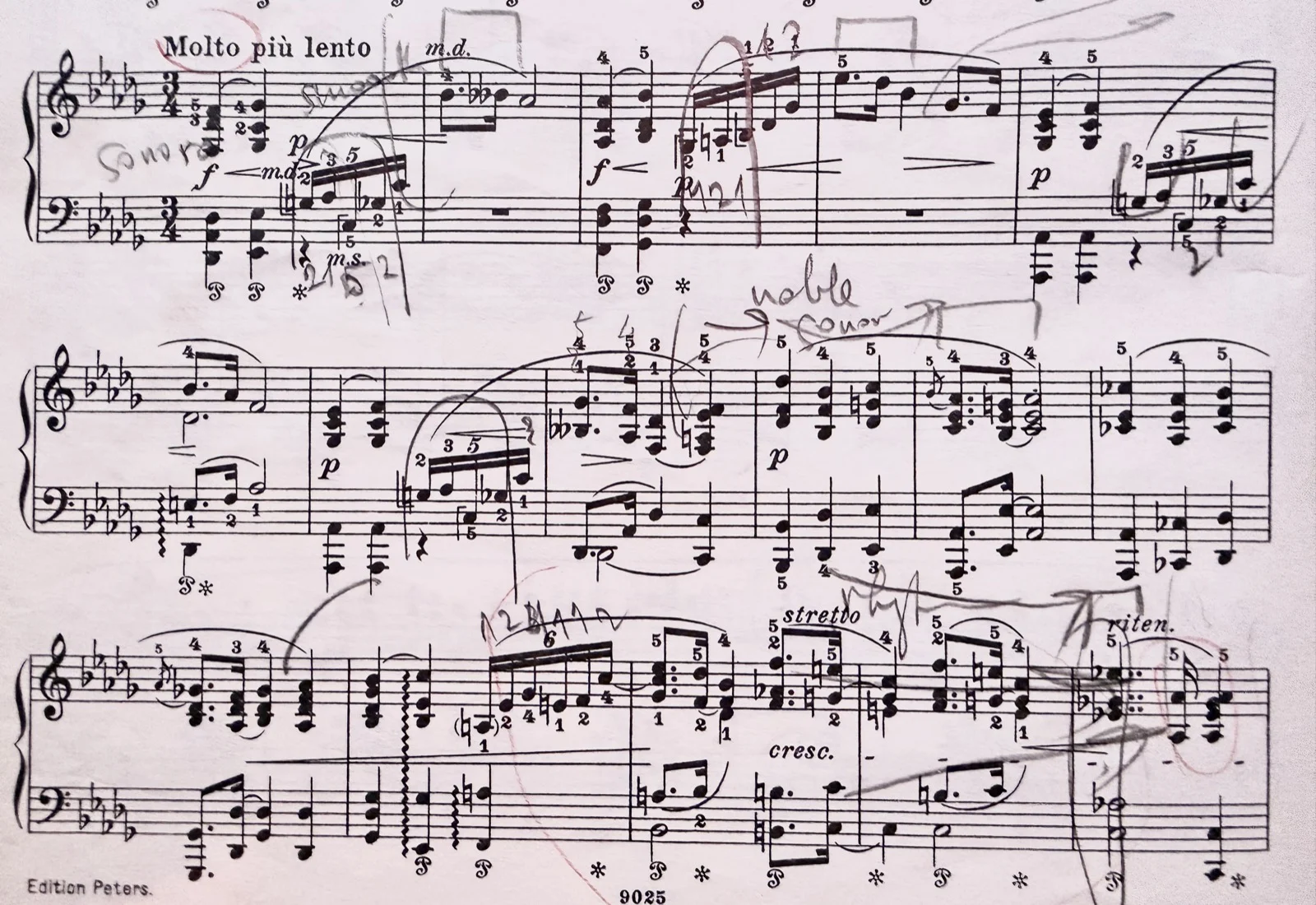
Once it is on the page, the eye has one organising target, and then the ear follows. You stop playing note-by-note and start playing toward-and-away. This is a lineage method, not a Piano Fantasy invention — which is part of why it holds up.
Keep the marking concrete. Do not soften it into "imagine where the phrase is going" — actually write it in. The mark is what makes the direction visible instead of vague.
Try this
Take a phrase you already know well — short enough that you can hear the whole of it at once.
- Find the gravity point: the note or small group the phrase is pulling toward. Write it into the score.
- Play the phrase once in a deliberately neutral way — correct notes, no leaning, nothing arriving anywhere.
- Now play it again, letting the notes before the gravity point pull toward it, and the notes after ease away from it.
- Listen to the difference. The neutral version is the row of well-played notes; the second one has an arc.
- Try the release a few ways — settling, letting go, or still leaning outward — and keep whichever fits the music.
The comparing is the lesson. This is one way to shape a phrase: not by adding expression on top of the notes, but by letting them organise around the point they were always heading for.
In short
A phrase is going somewhere before you play it — and the place it pulls toward is the gravity point. Sometimes one note, sometimes a small group of two or three.
The notes before it lean in, the notes after ease away, and that pull-toward-then-away is what gives the line its arc. Without it, correct notes stay a row of well-played notes. With it, they become a phrase.
That organising — the notes gathering around the point they were heading for — is a core of what musical phrasing actually is.