Lars: When you listen to a great performer, a great pianist, or in any other instrument, a great violinist, you immediately hear that... you know you're listening to something great. It's impossible to mistake, even if you listen just to a few notes, if Horowitz plays it or Rubinstein plays it.
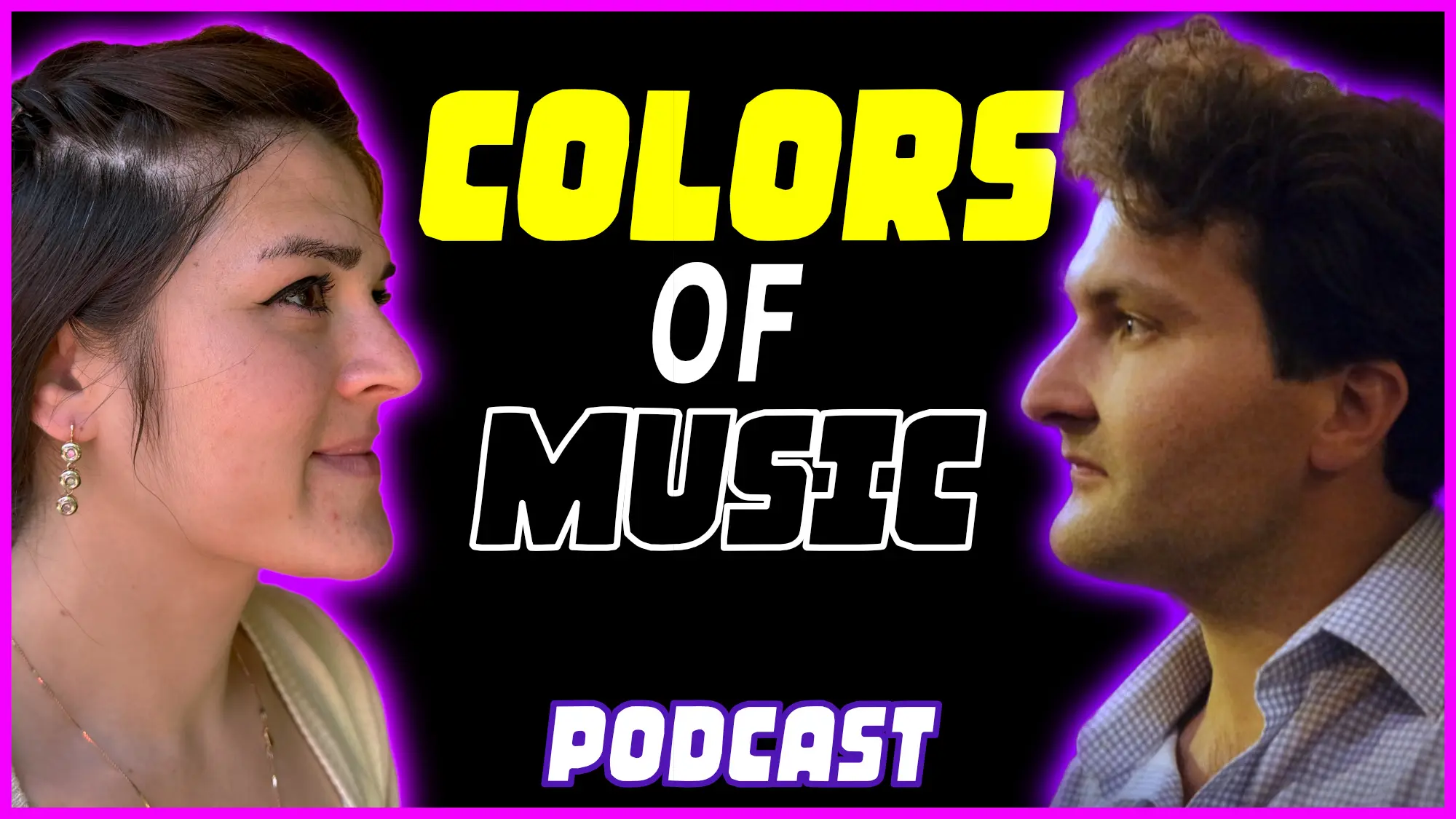
Zumi Rash: Hello, art lovers! Today we are invited to a music studio by Dutch pianist Lars Nelissen to have a conversation about art versus classical music. Thank you again for inviting me to your studio.
Lars: Music is like a painting with sound — with the colors of sound. The canvas is time. That's our canvas, because music happens in time. Without time there's no music, but without colors — sound colors — there's no music either. You have to arrange those musical colors in time.
How the technique to make the sounds, to look and search for these sounds — it has everything to do with the arm, the concentration of the fingers, the form in the hand, little micro-techniques.
Zumi Rash: When you don't have any technique, you simply don't play it through. With painting it's more confusing, I think, because many people, when they see paintings in galleries, they think "Oh, it's nice, it's beautiful" — but what work stands behind that? Many of them don't understand how much work a painter actually needs to put in.
Lars: I don't know if I feel myself free. I feel myself free when I'm improvising. When I'm composing, I don't feel so free anymore — because then I start to think, and the perfectionist personality starts taking over.
In the spring of 2023, Dutch classical pianist Lars Nelissen invited painter and arts journalist Zumi Rash to his studio for a conversation that moved between two disciplines without ever losing its thread. Over the course of an hour, they explored what music and painting share — the instinct for color, the architecture of a phrase, the line between honest craft and decoration — and where the two arts part ways. What follows is an edited version of that conversation, organized around its central themes. Lars's and Zumi's voices are preserved as their own.
On Sound as Color
Lars: Music is like a painting with sound — with the colors of sound. The canvas is time. That's our canvas, because music happens in time. Without time there's no music, but without colors, sound colors, there's no music either. You have to arrange those musical colors in time.
And how the technique to make the sounds, to look and search for these sounds — it has everything to do with the arm, with the concentration of the fingers, the form in the hand, and the little micro-techniques that are involved. To have an idea of what you want to do is one thing. But how to do it is another. And that is, I think, what mainly distinguishes the professional from the dilettante.
Zumi Rash: In fine art, the same problem sometimes stands. Many painters have great technique — they might have a very good technique — but artistically might suffer from lack of ideas or inspiration, and their paintings can look very dry and not so interesting. But on the other hand, some painters might not have such great technique, and yet their paintings look amazing. You get inspired, you get relaxed, you get all kinds of feelings when you look at them, because they put so much of themselves in that — so much of their own worldview.
Lars: When you listen to a great performer, a great pianist — or a great violinist — you immediately hear it. You know you're listening to something great. You can hear the individuality. It's impossible to mistake, even if you listen just to a few notes, if Horowitz plays it or Rubinstein plays it. They are so different. And that you don't hear from even the good dilettante, the good amateur. That's what makes the difference from the mediocre: not just good, not just correct, but present.
The art of soft playing is where much of this color-work happens — the control of dynamics is the control of atmosphere. And on the piano specifically, the pedal is one of the main tools for blending those harmonic colors — used partially, in the position between down and up, it is what lets one harmony bleed into the next rather than stopping cleanly at the bar line.
On Technique Versus Personality
Zumi Rash: You would advise people in art not to try to imitate or copy someone — but to try to put your own...
Lars: Not to try to be perfect. Not to try to have on the outside that everything is correct. Sometimes someone can have an excellent technique and have completely nothing to say in music. It's empty. What is important is that you not only do it on feeling, but also on knowledge and feeling together — that you know where to look for things. And that leads us to a very difficult question: what is good and what is not good?
Zumi Rash: I think when it's not obvious, time eventually shows what was good and what wasn't.
Lars: That's true. But when you listen to a great pianist, you know immediately. Even in competitions, sometimes I listen to young people playing — I cannot hear what makes this person special. Everything is good, everything is correct, but there's a lack of personality, even in the sound. It's decent but not interesting.
Zumi Rash: Yeah, and in fine art, people look at a painting and they think "oh, beautiful" about everything — about kitsch and about real art equally. For many people who are not educated in that way, they almost don't see the difference. That's why it is important to go to real galleries, the established ones, to read books about art, to educate yourself. Otherwise you don't understand the difference between kitsch and real art.
Lars: You must educate yourself a little bit, yes — read around the music you play, not just practise it. As Pierre Boulez — from the modern composers who knows the most about composition — if you like that music, you'll find a lot of great excellence in it. But there are also those who are just making noise. And it's a pity, because it dilutes from the real art and makes it difficult for the audience to know where the art is.
On the Lineage of Teaching
Lars: My teacher, Avi Schönfeld — he was a student of Arthur Rubinstein and he studied with Perlemuter in Paris. And Yvonne Lefébure, she was a student of Debussy. Vlado Perlemuter was the student of Ravel. Yvonne Lefébure was also the assistant teacher from Alfred Cortot, who is considered one of the greatest teacher-pianists from the Paris Conservatory in the past century. And Nadia Boulanger — he studied composition with her. Everyone who knows a little bit about music in this world knows the name Nadia Boulanger.
Zumi Rash: So your teacher got a lot of connections — people influenced each other, through, through, through — and they all influenced him.
Lars: Yes, and you got his influence eventually. In music we have that. And Rubinstein was a student of Karl Heinrich Barth, and Barth was the student of Liszt. From Liszt we go to Czerny and to Beethoven.
Zumi Rash: ...to your teacher's students. So you can draw this line. I think in fine art it is eventually the same kind of line.
Lars: He could make a passage in, let's say, a Chopin Nocturne, and transform it in such a way that the sound is just so beautiful. And how the technique to make the sounds — to look and search for these sounds — see, it has everything to do with the arm, with the concentration of the fingers, the form in the hand, and the little micro-techniques. That is what I really learned from him. And that is what I also try to teach in my own way.
On Improvisation and the Freedom of Not Planning
Lars: I feel myself free when I'm improvising. When I'm composing, I don't feel so free anymore — because then I start to think, and I start to be a little bit the perfectionist personality. When you improvise, you make what I consider a mistake, but people don't hear it. People think, "Oh, this man meant like that." Sometimes people don't even realize I'm improvising. They say, "What piece was that?" And I was just making it up.
Zumi Rash: With painters, it's the same. They use etudes — quick sketches, quick short studies — it is the same as improvisation in music. It brings a lot of ideas.
Lars: Yes, and from improvising, sometimes I think, "Hey, that's nice, sounds good, nice melody" — and then I write it down. But when you start to write it down, it's not improvising anymore, because you start to think. You start to see that the structure must be like this, it's more logical — and it crystallizes into a composition. That's at least the way I come to composing.
And improvising makes you more flexible as a musician. For example, when you play a piece and you are somehow not sure — sometimes the memory is not always 100% — you have more flexibility to find your way back, because you see the logic more, you feel it. The ears tell you: "Ah, now this comes, and now that comes." And the fingers follow the ears.
On Travel, Culture, and Musical Color
Lars: In China I was sometimes amazed — in some piano shops, they have rooms with completely banged pianos. Because they play with very strong fingers. And you hear there a little girl, 10 or 11 years old, learning some Schubert — a Schubert Impromptu, repeating for hours the same passages very loud and with strong fingers. Very good for technique. But I was thinking: maybe also work a little bit on sound, on colors.
You will not find here so easily so many children who practise like that — that's my point. And therefore, when you look at piano competitions, it's not without reason that the majority are from Asia. That has to do with work mentality.
Zumi Rash: Japan, very traditional still?
Lars: From the countries I went to, Japan is the most traditional. The two extremes — very modern, and in that modernism they preserve their history very well. In Tokyo you have both: the completely modern environment and the preserved historical one. That's very different than in China, because during Mao's time many artifacts and buildings were destroyed. Now they try to restore and rebuild.
I like to use the Japanese pentatonic scale when I improvise — it has something sad, something melancholic, something bitter in it. Very different than the Chinese pentatonic scale. And you learn the difference between two cultures which have from ancient times the same roots, but have developed such different colors.
For the girl in China, the loud work with strong fingers was the right first step. How Lars brings the sound in alongside that work, from early on, is in how to improve tone on piano.
Lars: Fine art and classical music — these two worlds are not so much different from each other. I think they are quite similar in many points. They only express themselves in different ways, through different subjects and instruments.
Zumi Rash: Music is like painting with sound. With the colors of sound, and the canvas is time — because music happens in time. Without time there's no music. You have to arrange those musical colors in time. That is what I like to call: the painting with sound. A painting that develops in time.
Lars: And paintings freeze the time. They are like a memory, like something which brings you back — to your own memories, to emotions. But at the same time, many painters get inspired by music. When I listen to some classical music I get many inspirations, and it brings me to the mood to create more art. We influence each other. And I think even that when painters and musicians start to work together they might make some great work. It's really very important sometimes to mix these two directions and bring something new from it.
Shaping piano tone is the practical work this conversation points toward. Improving sound in Kabalevsky's Lullaby is a good starting point for that work. On the broader question of what a musical life looks like, becoming a professional pianist covers the practical side of what Lars describes as "doing the work." And if the conversation left you wondering why a melody doesn't always come through: why a melody still doesn't sing goes directly there.