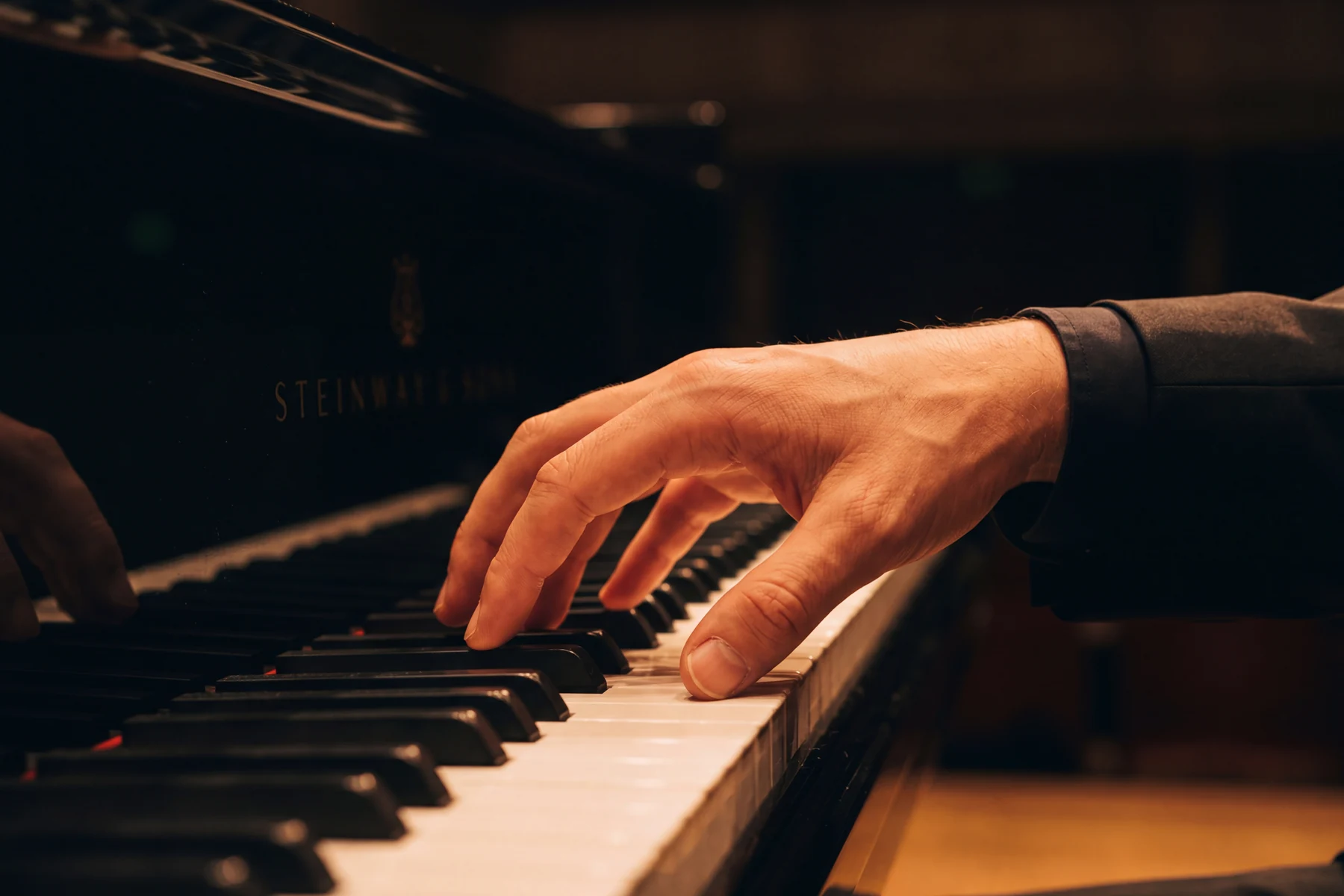
A good hand at the piano is round and free — arched, but never rigid. That word arched makes some players nervous, because they have usually heard it paired with a high, tense hand and a lifted wrist. That is not what this is. The arch is not a pose you hold up with effort. It is the shape a relaxed hand keeps on its own when it rests, supported, on the keys.
The umbrella hand already names that shape — gently open, curved, alive. This piece is about what sits underneath it: where the hand's support actually comes from, and where its tone actually comes from.
A hand that rests, not a hand that grips
An arched hand is a hand that rests on its own structure, not a hand that grips the keys.
This is the distinction most players miss, and it changes everything about how the hand feels. A gripping hand works to hold its shape — the fingers press in, the palm tightens, and within a few bars the whole thing is tired. A resting hand does no such work. The shape is simply there, held by the way the hand is built, so the effort you have left over can go into the music instead of into holding your own hand together.
So "arched" and "free" are not in tension. A hand can be well arched and completely free at the same time — in fact that is the only kind of arch worth having. The moment the arch costs you tension, you have stopped resting and started gripping, and you are back to the high, tight hand nobody wants.
Arched from the knuckles: what actually holds the hand up
The arch of the hand springs from the base joints of the fingers — the bridge of the hand — and that is what holds everything up.
Think of how a stone arch stands. It does not stand because someone is pushing up on it from below. It stands because of its own shape, resting on the columns at its feet. The hand is the same: the bridge across the base joints is the arch, and the fingers underneath are the columns it rests on. Nothing has to be lifted or braced. The structure carries itself.
The knuckles as the keystone
The base joints are the keystone of that arch — the place the whole shape is organised from. When they stay gently raised and open, the arch is intact and the fingers hang below it, ready. When they cave in, the arch flattens and the hand loses its support in an instant, no matter what the fingertips are doing.
This is why the feeling of the hand lives at the bridge, not at the fingertips. The fingertips play the notes; the bridge is what lets them.
Why "relax" alone gives no sound
"Relax" is only half of the instruction, and taken on its own it quietly fails. A hand told only to relax goes soft — and a soft hand gives no sound, because a limp finger absorbs the arm's weight instead of passing it into the key. That is exactly the collapse that makes tone unreliable: the energy is already there, but the hand swallows it before it reaches the key.
The arch is what lets relaxation actually produce sound. The hand is free and supported — loose enough to move, structured enough to carry weight through. Freedom without support is collapse; support without freedom is tension. The arch is the state where neither of those happens.
The wrist hangs, the fingers support
The wrist hangs free and holds nothing; the fingers give the support.
This is the correction I most often have to make, because it is easy to get exactly backwards. Players hear "free wrist" and let the whole hand go limp — and now nothing is holding the shape. Or they hear "support" and stiffen the wrist to provide it — and now the arm is blocked. Both come from putting the support in the wrong place.
The wrist's job is to hold nothing. It hangs freely at a naturally low, supple height — low not because you press it down, but because a thing that hangs freely settles low on its own. Low is a result of freedom, not a posture, and low is not the same as collapsed.
The support comes from below that, in the fingers and the arch they hold. So the picture is not a limp hand dangling off the wrist. It is a free-hanging wrist above a supported, arched hand — the wrist following the arm rather than leading it, while the fingers quietly do the holding.
Where the sound comes from: the arm's weight carried by the fingers
The tone is made as the finger delivers the arm's weight into the key — not at the knuckle.
It helps to separate two things that happen at the same joint. The flexibility of the fingers is centred at the base joints — that is where each finger pivots from, and it is what keeps the hand mobile. But the movement itself does not start there. It starts in the lower arm. The forearm gives the impulse, and the fingers, flexible at their base and stable in their arch, carry that impulse down into the key.
So the base joints are not where the sound is made. Their job is to hold the arch and give the hand its support. The tone happens further along the chain — when the arm's weight passes through a concentrated finger into the key. The arch supports; the arm supplies the weight; the finger delivers it. That is the whole mechanism, and it is why a full, beautiful sound does not come from the fingers working alone.
This is also why the hand is only one part of a single coordinated system. The arch, the free wrist, the arm behind it — none of them makes a sound by itself. They make it together.
Shape colours the sound: rounder for clarity, flatter for warmth
Inside this one arched hand, a slightly rounder or slightly flatter finger changes the colour of the sound.
Rounder, freer finger action gives more clarity and articulation — the notes speak cleanly, each one defined. A slightly flatter finger, with more of the cushion on the key, gives a warmer, more sustained tone that blends. Neither is correct and the other wrong. The music tells you which one a passage wants, and that choice is one of your real tools for colour.
There is one thing that stays true across the whole range, though, and it is worth saying plainly: flatter is never floppy or shapeless. Even the flattest finger keeps a shape and a structure. The colour changes; the support does not.
The feeling to return to
The feeling to return to is simple: a hand that rests, a wrist that hangs, fingers that quietly hold the arch.
Nothing lifted. Nothing gripped. The arm behind it, ready to give its weight.
When the hand feels like that — supported without effort, free without collapse — the sound has somewhere to come from, and you are no longer fighting your own hand to make it.
Where this is built step by step
We build the arched, supported hand from the ground up in my e-book, Super Fingers (Book 1) — where the shape, the free wrist, and the arm behind them are trained as one thing rather than three. Inside the Piano Fantasy Academy it is developed gradually into real playing, so that resting, supported feeling becomes the hand you start from without having to think about it.
You can keep experimenting on your own, or follow a clear system that builds this foundation, step by step.