Why "always curve your fingers" is the wrong rule
Most pianists were taught one sentence about finger shape: curve your fingers. It is not wrong so much as incomplete — and an incomplete rule, applied everywhere, quietly limits the sound you can make. Curved fingers are the right default for most of what you play. But "always" turns a useful default into a cage, and the cage is audible: every passage ends up with the same bright, articulated surface, even the ones that wanted to be warm.
Finger shape is not a rule to obey. It is a decision you make for the sound you want — and once you hear it that way, you stop asking "is my hand correct?" and start asking "is this the colour the music needs?" That shift is not about practising harder. It is about being taught what the choice is actually for.
The sound you want also guides how you practise, not only which finger shape you choose. You keep it in mind from early on, even while the fingers still work loud and strong, and you search for it with the arm movement. I explain that order in my post on how to improve tone on piano.
Two colours on the same palette
Think of curved and slightly flatter fingers as two colours on one sound palette, not as a right answer and a wrong one.
More curved fingers are the default for clarity, articulation, and structural support. The curve gives the finger the structure to pass the arm's weight cleanly into the key without losing energy on the way. This is what you want in scales, fast passages, and anywhere each note needs to speak distinctly.
Slightly flatter fingers bring warmth and blend. A broader contact between the cushion of the fingertip and the key produces a rounder, less percussive tone. This is what melodies often want, and it frequently feels natural on black keys, where the raised surface invites a wider contact.
Neither is more advanced than the other. They answer different musical questions, and a player who only owns one of them can only answer half the questions the music asks.
Why the shape changes the sound at all
It is worth being concrete about why the shape changes the tone, because "curved is brighter, flatter is warmer" is true but it sounds arbitrary until you see what is actually happening where the finger meets the key. The difference is the contact surface, and the contact surface changes the character of the attack.
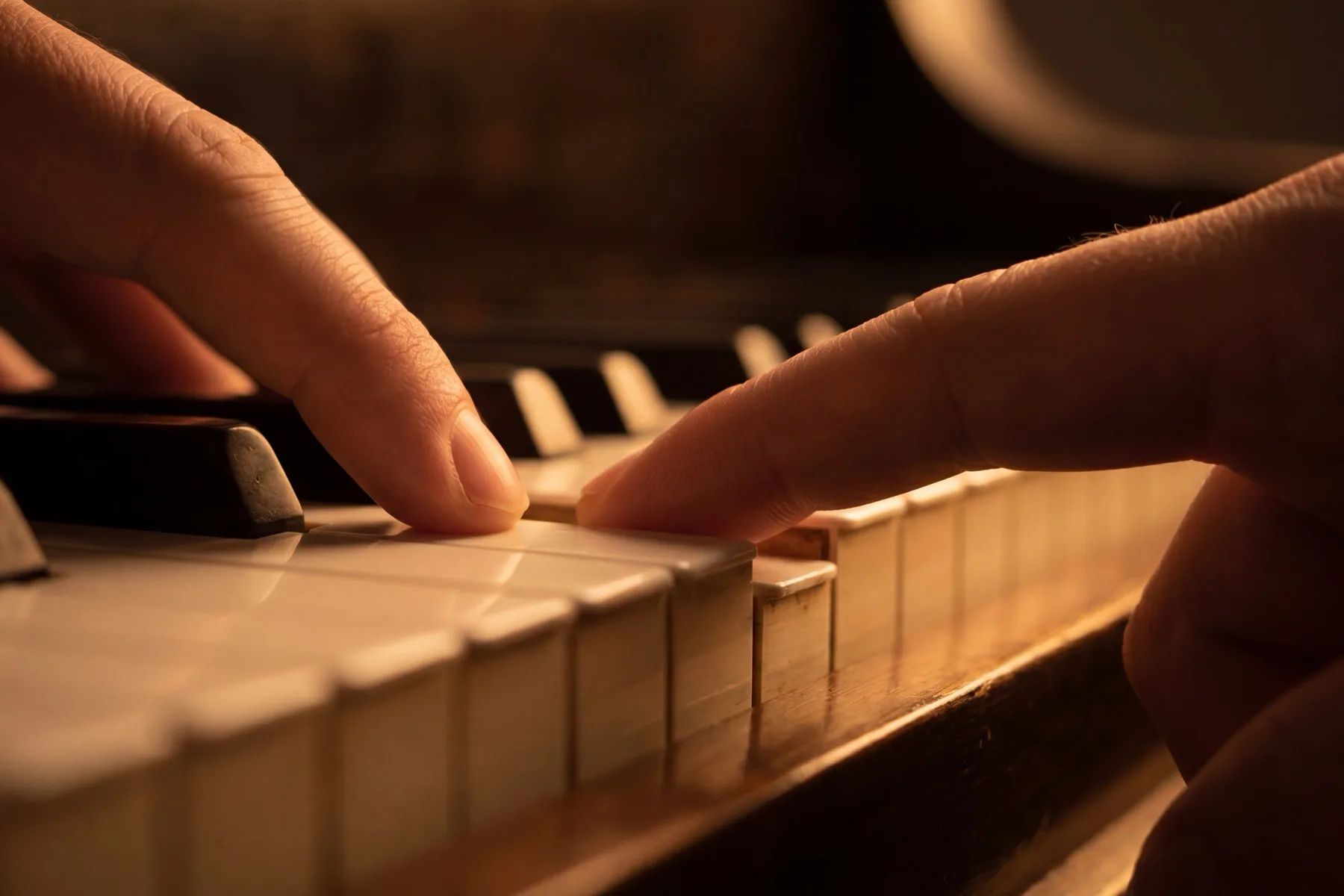
A more curved finger meets the key on a narrow point — closer to the hard tip. That narrow contact delivers the arm's weight into the key over a small, well-defined area, and the onset of the sound is correspondingly defined: cleaner, more articulated, more present.
This is the same reason the curve is the default for clarity. The structure that lets a concentrated finger transmit weight without collapsing also concentrates that weight into a precise, crisp point of attack. Clarity is not a separate property bolted onto the curved shape — it is what a narrow, structured contact does to the sound.
A slightly flatter finger meets the key on a broader area — the cushion of the fingertip rather than the tip itself. The same weight is now spread across a wider contact, and the onset of the sound spreads with it: rounder, less percussive, more blended. Nothing about the weight or the effort has changed; the energy simply arrives over a broader surface, and a broader arrival makes a less pointed sound. That is the whole mechanism.
It is why the cushion contact reliably produces a warmer colour and the tip contact a more crisp one — not as a rule someone decided, but as a direct consequence of how wide the meeting point is.
This is what makes the curved-or-flatter decision a genuinely tonal one rather than a posture you adopt and forget. You are not choosing a "correct" hand and hoping the sound follows. You are choosing how the weight arrives at the key, and therefore the character of every note's onset, before you play it. The shape is the first decision about the colour — not a separate matter from it.
What "flatter" does not mean
There is one way this idea gets misused, and it is worth naming. Flatter does not mean floppy. A slightly flatter finger still has structure — it is still a stable, concentrated finger; it has simply changed its contact with the key, not abandoned its support. A finger that has gone soft and collapsed is not making a warm sound on purpose. It is failing to transmit weight, and the tone goes weak and unreliable.
The distinction is exact: a flatter finger is a different structured contact, not the absence of structure. Both the curved and the flatter version rest on the same underlying support — the arch across the base joints that holds the hand up in either shape.
This is also why "play with flat fingers" is poor instruction on its own — without the qualifier it invites a complete flattening of the hand, which is never the intent. The useful instruction is slightly flatter, broader contact, the cushion of the fingertip — language that keeps the structure while changing the colour.
How to actually hear the difference
Take a simple melody you already know and play it twice:
- Once with clearly curved fingers.
- Once with a slightly flatter, broader contact.
Do not decide which is "correct" — listen for how the tone itself changes: the curved version more defined and present, the flatter version rounder and more blended.
Then do the same with a fast figure instead of a melody:
- Once with clearly curved fingers.
- Once with a slightly flatter contact.
You will usually hear the opposite preference — the curved shape giving you the clarity the quick notes need, the flatter shape blurring them.
You are not auditioning for the right hand position. You are matching a touch to a sound. The same principle governs how high a finger should lift — which physical choice serves this sound, here? It also scales up into real repertoire: the shape you choose interacts with how you voice one line above another in the same hand and with the broader technique system that turns physical choices into musical ones. Curved or flat is the smallest version of a question you will keep answering at every level. The same question comes back at the other end of the note, in how the key comes up, with the pedal up and with the pedal down. That is its own choice, separate from the finger shape, and it has its own post: how you end a note on the piano.
That question never has one permanent answer — and that is the point. The goal is not a single correct hand. It is the freedom to choose. That freedom is not the reward for working harder. It is the result of getting better instruction.