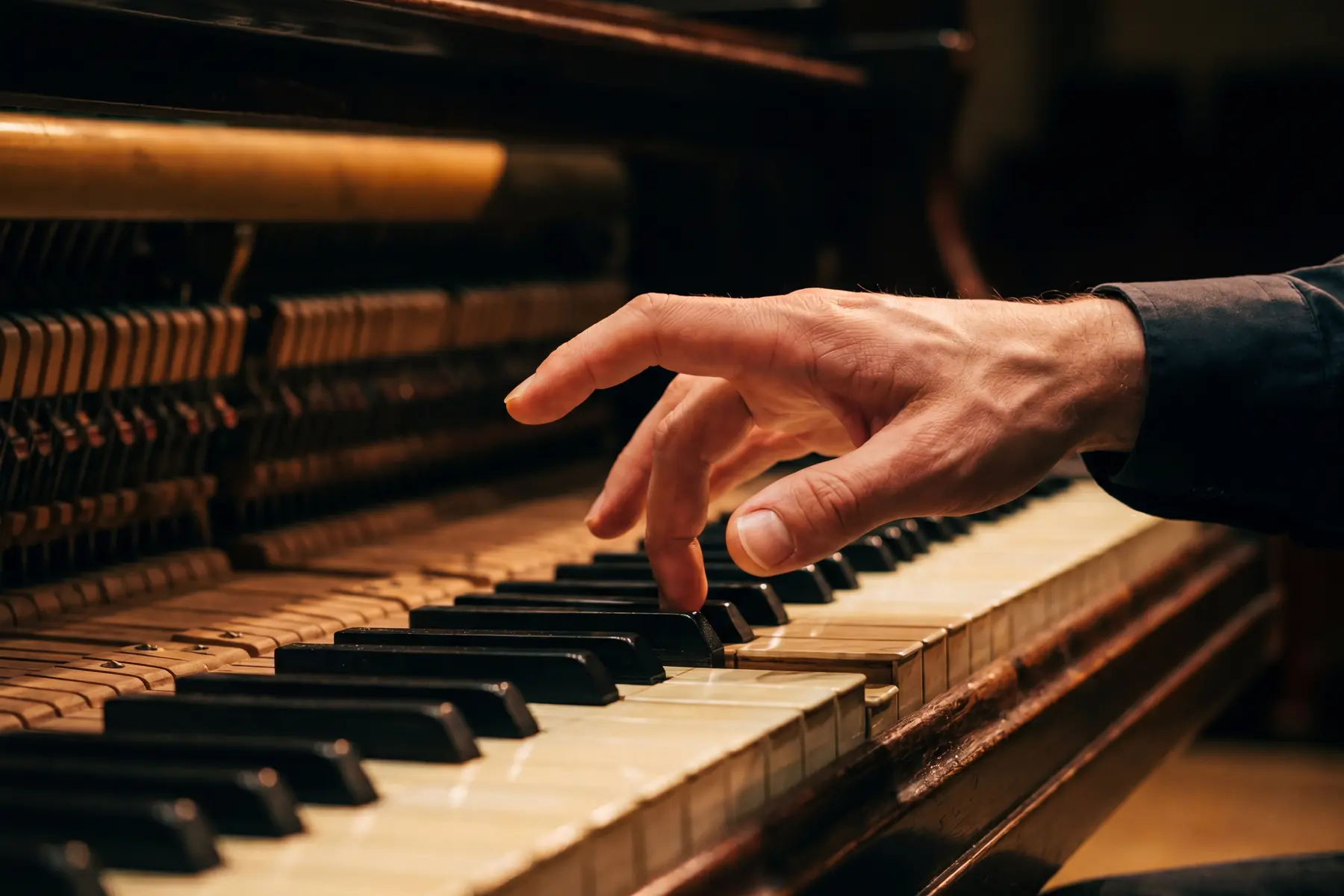
There is a short answer and an honest answer. The short answer is "it depends." The honest answer is more useful: how high you lift a finger depends on what the lift is for, and the lift is doing one job while you are learning a passage and a completely different job once you can play it.
High lifting is a learning tool, not a performance setting
When a passage is fast, your fingers want to stay close to the keys — and that instinct is correct. You will not play a quick run with the fingers swinging up high; the distance would slow you down and the sound would turn into a series of separate hammer-blows instead of a line.
So why does anyone tell you to lift high at all? Because lifting high during practice and lifting high during performance are not the same activity. In practice, a deliberately raised finger is a way of teaching the hand. It exaggerates the movement so that each finger learns, very precisely, where it is going and how to get there cleanly. It is closer to strength-and-clarity training than to playing. The version you eventually perform keeps almost none of that visible motion — but it is built on it.
This is the distinction most "lift your fingers" advice skips, and skipping it is why the advice so often backfires. It was never about working the fingers harder. It was about being taught what the lift is for.
What a raised finger actually trains
A high, deliberate finger raise in slow practice builds three things at once:
- Precision of attack — the finger learns its exact target instead of approximating it.
- Independence — when one finger lifts clearly and the others stay quiet, the hand learns to move one finger at a time without dragging the neighbours along.
- The reflex you will later use close to the keys — the clean, fast strike is grooved at a slow tempo so it survives when the visible motion disappears.
The strike itself matters as much as the height. A raised finger that then presses slowly into the key teaches nothing useful — it just rehearses sluggishness. The movement is: lift to a comfortable height, then strike quickly into the key. Height plus a fast strike builds clarity. Height plus a slow press builds a habit you will have to undo.
Throughout all of this, the hand stays in its open, curved, ready shape — the default hand position your fingers move inside of rather than from a flattened or clenched hand. The lift happens within that organised shape; it is not a separate gymnastic.
Why the height shrinks as the passage matures
If high lifting is so useful, why not keep it? Because it has done its job. This is the same logic that runs through every well-built phase of Super Fingers practice: the early, exaggerated, finger-focused work is the laboratory; the later work folds that clarity into a fast, close, almost invisible touch. The big movement of the early phase is supposed to disappear. If it is still visibly there at full tempo, the passage has not finished maturing — the height was practised but never integrated.
So the honest answer to "how high should fingers lift" changes across the life of a passage:
- Early, slow, learning the notes: lift high — as high as is still comfortable and controlled — and strike fast. You are teaching the hand.
- Mid-stage, building flow: the lift starts to come down on its own as the passage becomes secure. Let it; do not force it to stay high.
- At tempo: the fingers stay close to the keys. The clarity you built with the high lift is now carried in a small, fast, precise touch.
How lift pairs with finger shape and preparation
Finger height is one of two decisions the hand is making at the same time. The other is finger shape. A curved or slightly flatter finger is a tonal choice, and the lift you use rides on top of whichever shape the sound calls for — a high, clear raise in a passage that needs articulated brilliance; a smaller, closer motion where the line wants warmth and connection.
Lift is also a form of preparation, the same staged training my e-book, Super Fingers is built on. A finger raised in advance of its note is, in effect, a finger already getting ready before it plays — which is why high practice trains far more than the strike itself. It trains the habit of organising the movement before the sound, which is the foundation everything faster is built on.
None of this is hidden knowledge or a matter of practising more grimly. It is a matter of knowing what the lift is for, and when. That is not about working harder. It is about getting better instruction — and then letting the exaggerated motion quietly disappear into real playing.