A full pedal change — all the way up, then all the way down — clears the resonance completely. Very often that is exactly what a passage needs: a clean break between one harmony and the next.
But not every passage wants that much clearing. Some need less than a full change gives.
When you clear everything, you sometimes also clear the resonance that was holding the harmony together — and the sound goes thin. That narrow gap, between clearing everything and holding everything, is where half pedaling lives.
What half pedaling actually is
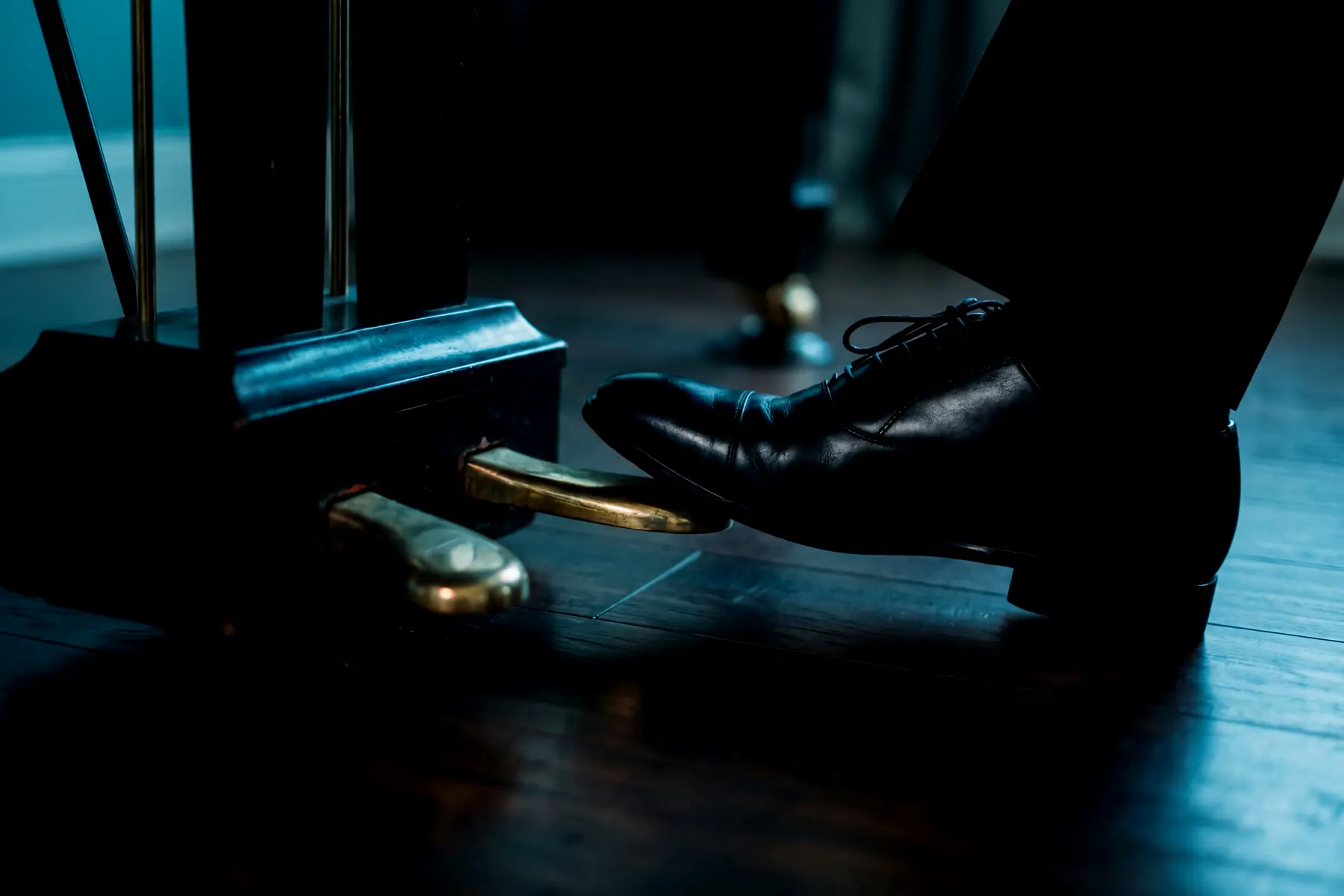
Half pedaling on the piano is pedaling to a middle position — somewhere between fully down and fully up — so the dampers only partly touch the strings and only part of the resonance is cleared. It is the position between fully sustained and fully cleared.
In practice it shows up in two related ways, and it helps to keep them apart:
- Partial depression — the pedal goes down only partway, so the dampers rest lightly on the strings instead of lifting off them completely. The strings keep ringing, but less freely.
- Quick change — from a full pedal, you change the pedal very quickly. It is quick enough that the dampers don't get time to damp the whole vibration of the strings, so some of the accumulated blur clears while the rest keeps ringing.
And half is only one point on a scale. You also hear pianists talk about a third pedal, a quarter pedal, or a three-quarter pedal. That is exactly what I teach my students, too.
The mechanism is easy to misread. It is not that you change the pedal a third of the way down. It is that you change the pedal lightly — light enough that just a third of the sound is filtered out, while the rest keeps sustaining.
The others work the same way. A quarter pedal filters out roughly a quarter of the sound; a three-quarter pedal filters out about three-quarters of it. In each case the rest is sustained.
So it is about how much of the sound is filtered out — not how far the pedal moves. That is the effect.
The point is not to memorise fixed fractions. There is a whole gradation, and each one filters out a different amount of the sound.
Why a full pedal change sometimes removes too much
When you make a full pedal change, everything above the dampers stops ringing at once. Between two clearly separate harmonies, that is exactly right — the old chord gets out of the way of the new one.
But harmony is not always that clean-edged. Sometimes a bass note or an inner voice is still doing real work under the surface when the next change arrives.
Clear it completely and the harmony that depended on it goes bare. The passage still has all its notes, but the warmth that was holding it together is gone — and you can hear that something left.
That is the case half pedaling is for: when a full change would take away resonance the music was still using.
The ear decides in real time, not a formula
There is no fixed amount to lift. How much you clear depends on the harmony, the register, the room, the tempo — and all of that is moving while you play. So the amount is not something you can write into the score once and stop thinking about. It is decided in the moment, by the ear.
This is the same principle behind the pedal following the ear, not the beat: that post is about when to change; this one is about how much to clear. Both answers come from the same place — listening to the sound as it actually rings, not executing a plan.
It is listening while you practise, applied here to the foot: you are training the ear to notice how much resonance the harmony needs, and letting the foot respond to what it hears.
Quick change vs. partial change
The two ways above are worth separating a little further, because they are easy to blur together.
A quick change is about speed. From a full pedal, the pedal changes fast — fast enough that the dampers never get time to damp the whole vibration, so some ring stays.
A partial change is about depth. The pedal only goes partway down, so the dampers rest lightly on the strings rather than clearing them completely. Here it is the distance, not the speed, that keeps some ring.
They can feel similar, and they often overlap in real playing, but they are not the same motion — and knowing which one a passage wants is part of the control you are building.
Where half pedaling lives in the music
Some of this comes down to how the piano itself resonates. Bass notes tend to resonate longer, while the mid and upper range clears more quickly. That difference is exactly where half pedaling earns its place.
Take a bass note that has to sound through a bar or more, with brilliant passagework running above it. Change the pedal fully and you lose the bass; leave it down and the passagework turns muddy. A quarter-pedal change — clearing a little while keeping the bass — can save the passage, letting the top stay clear while the foundation keeps ringing.
To play Chopin, Liszt or Debussy without half pedaling is close to unthinkable — the writing simply assumes this kind of control.
And in composers like Debussy and Scriabin the pedal takes on a whole extra dimension: their colors depend on harmonies blending into one another, and it is the pedal, used partially, that does much of the blending. That is the blending of harmonic colors made physical — a color decision carried out by the foot.
At the far end of that same world sits the vibrato pedal. It is a very quick, slight up-and-down movement of the sustain pedal — not a full change, just a small shimmer of the foot — that gives the sound a special vibration.
It is an advanced expressive color; you can hear great pianists reach for it, Martha Argerich among them. Nothing to drill here — only one more sign that between fully down and fully up there is a whole world, and the pedal is an expressive tool the ear reaches for, not a formula.
Try this
Take a phrase with some slight harmonic changes — preferably in Romantic-period music: Chopin, Liszt, Brahms, Schumann, or Debussy, Scriabin, Ravel.
- Play it first with full pedal changes — all the way up, all the way down.
- Listen to what disappears at each change, and notice whether it was needed.
- Now try a partial change — the pedal only partway down, listen for the shift, then change again.
- Ask which clearing served the phrase better.
The answer will not be the same for every piece, every room, or every tempo. That is the point: the ear is learning to decide in real time, and the foot is learning to carry out what the ear decides.
In short
Some passages need the clean break of a full change. Others need the middle position — enough release to clear the blur, not so much that the sound goes bare.
Half pedaling is not a formula to memorise. It is something the ear develops, once you start asking at each harmonic change: is a full change too abrupt here, or does a partial change serve the phrase better?
Common questions about half pedaling
What is half pedaling on the piano? Half pedaling is pressing the sustain pedal to a middle position — between fully down and fully up — so only part of the resonance is cleared. Instead of a clean on/off, you keep some ring and let some go.
How is half pedaling different from a full pedal change? A full change clears all the resonance at once — a clean break between harmonies. Half pedaling clears only part of it, so some of the sound carries through. You use a full change when two harmonies need to stay separate, and half pedaling when clearing everything would take away resonance the music still needs.
When should you use half pedaling? Most often when a bass note or inner voice needs to keep ringing while faster notes above it would otherwise blur together — and, more broadly, in music where harmonies are meant to blend, as in Debussy and Scriabin. There is no fixed rule; the ear decides how much to clear.
None of this is a trick you add on top of your playing. It is a way of listening that grows — from simple harmonic situations to real music at tempo — until the pedal becomes part of how you hear harmony, not just a rhythm your foot keeps. You can keep experimenting on your own, or follow a system that builds this control step by step, in order.