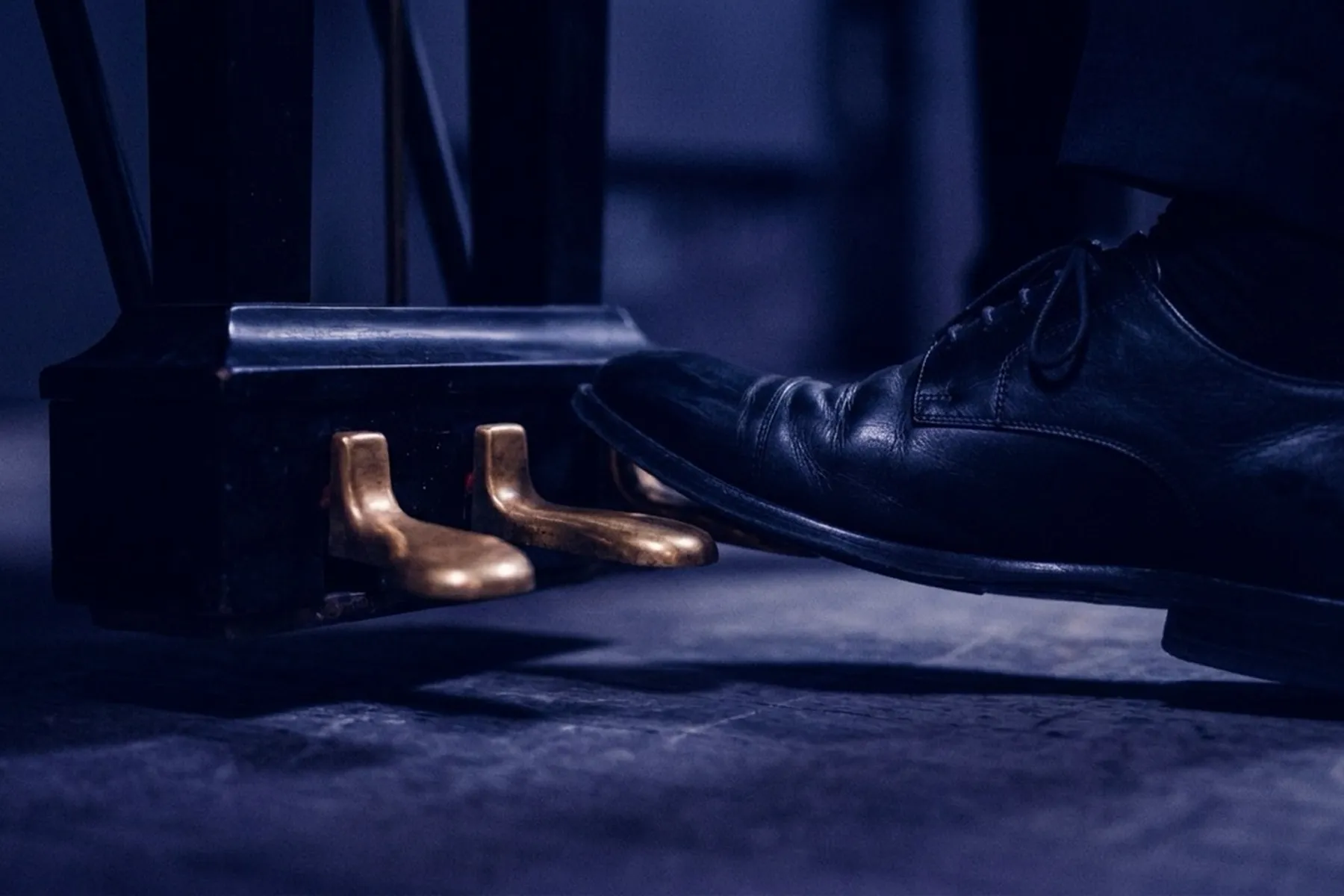
Almost everyone is taught to pedal the same way at first: press on beat one, change on beat three. It is a reasonable place to begin.
But it is a starting point that has to be left behind, and the reason it has to be left behind is worth hearing clearly — because the count is not a small inaccuracy. It is the wrong organising principle.
What a counted pedal actually does to the sound
A counted pedal pattern has one fatal property: it is not listening to anything. It is executing a memorised rhythm, and a rhythm executed blind will always be wrong somewhere — because the thing the pedal is supposed to be responding to does not keep to the beat.
Hear what the count actually produces. When the pedal changes on a count instead of on the sound, it changes a fraction too early or a fraction too late relative to what the harmony is doing.
- Too late, and the old harmony is still ringing under the new one — the sound smears, a blur the count cannot hear because the count is not listening for it.
- Too early, and the line is clipped — a connection the music wanted is cut off before it finished.
Either way the count produced it, and either way the player following the count has no way of noticing, because their attention is on the number, not the sound. That is the real problem with counted pedaling: not that it is occasionally inaccurate, but that it removes the ear from the one job the ear should be doing.
The pedal belongs to the ear, not the beat
Here is the principle that replaces the count. The pedal does not belong to the beat. It belongs to what the ear needs.
The pedal goes down when the sound needs to continue and stay connected. It lifts and changes when the harmony moves on and the previous resonance would muddy what comes next.
Those moments are decided by the harmony and heard by the ear — and they do not reliably fall on the beat. Sometimes the harmony changes slightly before the beat, sometimes slightly after it. A counted pedal cannot find those moments because it is not looking for them; only the ear can. The ear hears the change; the foot follows the ear.
There is one piece of timing worth being exact about, because it is easy to get backwards. When the harmony changes, the cleanest result does not come from changing the pedal at the moment the chord changes. It comes from letting the new chord sound first, then — a fraction after it has spoken — releasing and re-depressing the pedal.
That brief gap lets the new harmony register cleanly before the old one is let go. How long that fraction is, is itself an ear decision: a little more overlap blends the harmonies more; a little less keeps them more separated. The count has no access to this control at all. The ear has all of it.
Practise it without the count
Take a phrase you are already comfortable with:
- First, play it with no pedal at all, and listen — where do the notes disconnect? Where does the sound genuinely need to continue and the fingers cannot hold it?
- Add pedal only at those places.
- Then listen for where the harmony shifts, and let the foot follow that shift — changing a fraction after the new harmony has sounded, not on the count.
You will almost certainly find the pedal moments are more varied than any fixed pattern would predict. Some passages need more coverage, some need much less, and the ear is making that decision in real time — not the bar lines.
This is the same skill as practising by listening rather than by executing: ear-led pedaling is simply that habit applied to the foot. It is also what protects real legato instead of hiding its absence — pedal used by ear supports the finger-timing connection that true legato is actually made of, rather than smearing over fingers that never learned to connect.
Why the count was a crutch, not a method
It is worth naming what the count actually was. It was a scaffold — useful for the very first encounter with the pedal, like training wheels, and like training wheels it stops being help and starts being limitation the moment you can balance without it.
Leaning on the count permanently is the same error as leaning permanently on the metronome as a master rather than a temporary diagnostic: both replace listening with a number, and both eventually cap what you can hear. And counted pedaling is one quiet, common reason a phrase ends up sounding flat — the connections fall mechanically instead of where the line actually needed them.
The pedal, in the end, is not a rhythm event. It is a listening event. The foot moves when the ear hears that the resonance has become a problem, or that the sound needs to keep going — and that is a fundamentally different act from counting beats. Learning it is not a matter of counting more carefully. It is a matter of getting better instruction about what the pedal was always for.
Timing is only half of it. The other half is how much resonance to clear — the pedal position between down and up: this post is about when the ear should move the foot; that one is about how far.