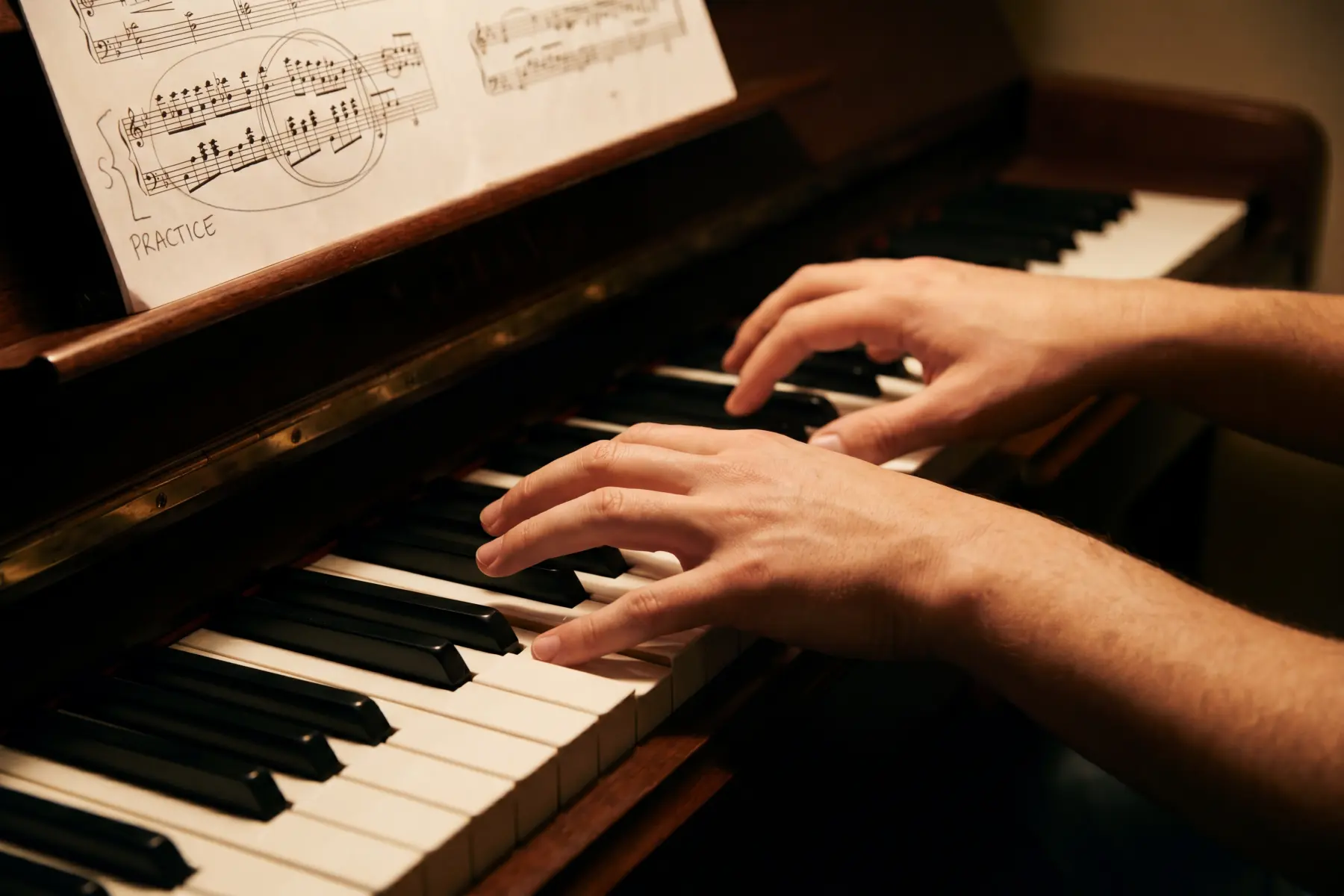
If you want better piano technique and more efficient practice, the single most useful change you can make is this: learn to fix the difficult spot first, instead of restarting the whole piece from the beginning every time.
It is one of the most common practice habits, and one of the quietest ways to spend an hour at the piano without actually getting better.
Why Restarting From the Top Buries the Problem
Here is what it usually looks like. You start a piece at bar one. You play until it gets difficult — a run, a jump, a turn that never quite settles. Something stumbles. And almost before you have decided anything, the hand goes back to the beginning and starts again.
It feels logical. It feels disciplined. It feels like real practice.
But notice what is actually happening. Every restart sends you through the bars that already work — many times — and into the one spot that does not — once, badly, before you flee back to safety. The easy bars get more familiar. The hard spot stays exactly as hard as it was, because you never really worked on it. You only kept arriving at it tired and leaving it unsolved.
This is not a discipline problem. It is an instruction gap: most players were simply never shown that the run-through and the repair are two different kinds of work, and that confusing them is what makes a hard passage stay hard.
Where the Real Work Happens
Most technical progress at the piano is made away from full run-throughs. It happens when you stop repeating the whole piece and start solving the specific problem inside it.
Progress comes from working on small, isolated parts. That is where coordination improves. That is where tension is reduced. That is where control is actually built — in a few notes you can see clearly, not in a whole page you are rushing through. And slow practice here does not mean dragging the whole piece blindly; it means taking that isolated problem unit down to the tempo at which nothing is left to luck, the speed where the spot is genuinely made correct rather than approximately survived.
Playing a piece from beginning to end is not wrong. But on its own, it is rarely enough. Real progress happens when you learn to practise the problem, not just repeat what already works. And before you replay anything, it is worth being honest about whether the last attempt was actually good or only nearly good — it is often better to fix a passage before you repeat it, not after, because a not-yet-right version, repeated, only becomes a familiar wrong version.
Effective practice means knowing when to zoom in, and when to zoom out again.
Finding the Spot That Actually Needs the Work
Instead of always starting at bar one, ask a few specific questions of the passage:
- Where does control disappear?
- Where does tension creep in?
- Where does clarity break down?
- Where does the tempo slow down or speed up without you deciding it?
- Where does the hand stop feeling prepared before the notes arrive?
That is where focused practice should begin — not at the start of the piece, but at the start of the trouble.
Often the breakdown is not where you think it is. The note that misses is frequently the result of something that went wrong a beat or two earlier — the cause usually lives a beat or two earlier — here is how to name it — a hand that arrived late, a finger that was not ready.
When you cannot tell which note is the real problem, raising the tempo a notch on the metronome makes the breakdown audible — the spot that falls apart first under a little more speed is usually the spot that needed the work all along. Learning to hear the moment something actually changes is what turns "that felt bad" into "that specific finger, at that specific moment."
And sometimes it is not a note at all. The arm can arrive already tight, so the spot may be earlier than the bar that fails — earlier by sections, not by a beat.
A Simple Way to Repair a Difficult Spot
Once you have located the real trouble, the repair has an order. It is worth following deliberately rather than just playing the bar again, harder.
- Take the passage that feels unreliable, and isolate just a few difficult notes — often only the two to four notes around the actual break point, not the whole bar. When the break sits at a position change, the notes to isolate are the last note before the move and the first note after it, and the move between them is what gets practised. Then one note on each side is added, which fits the two to four notes of this step. How to practise that move is in how to shift hand positions on piano.
- Slow them down — slow enough that nothing is left to luck.
- Prepare the fingers before they play. Preparing the finger on its key before the note sounds, with a free arm and calm timing, is usually where the spot was failing in the first place — not in the note itself, but in the unprepared approach to it.
- Repeat this small unit — not mechanically, but experimenting each time, listening for what actually changes.
- When it is genuinely stable, reconnect it to the surrounding music and play slightly into the bars on either side.
The repeating part matters, but only once the version is right. A few clear repetitions teach more than many careless ones: repeating is not the problem — repeating the wrong thing is. And very often, fixing one tiny spot suddenly improves the whole phrase around it, because that spot was quietly costing you more than its few notes.
When Full Run-Throughs Become Useful Again
None of this means the full run-through has no place. Later — when the piece becomes more familiar, when the hard spots have actually been solved — playing from beginning to end becomes essential. Not for learning the notes anymore, but for confidence, flow, and continuity, especially if you plan to play for others.
So the rule is not "never run the whole piece." It is: zoom in to solve problems, zoom out to build confidence — and do not confuse the two. Good practice needs both, in that order. The difficult passage does not get easier by being played through more times. It gets easier when you finally stop running past it and start working on it.
This balance is built into the way practice is taught inside Piano Fantasy Academy — short, focused work that leads naturally into fluent, full run-throughs, so the shift from "playing the piece" to "practising the problem" stops being something you remember to do and becomes simply how you work.