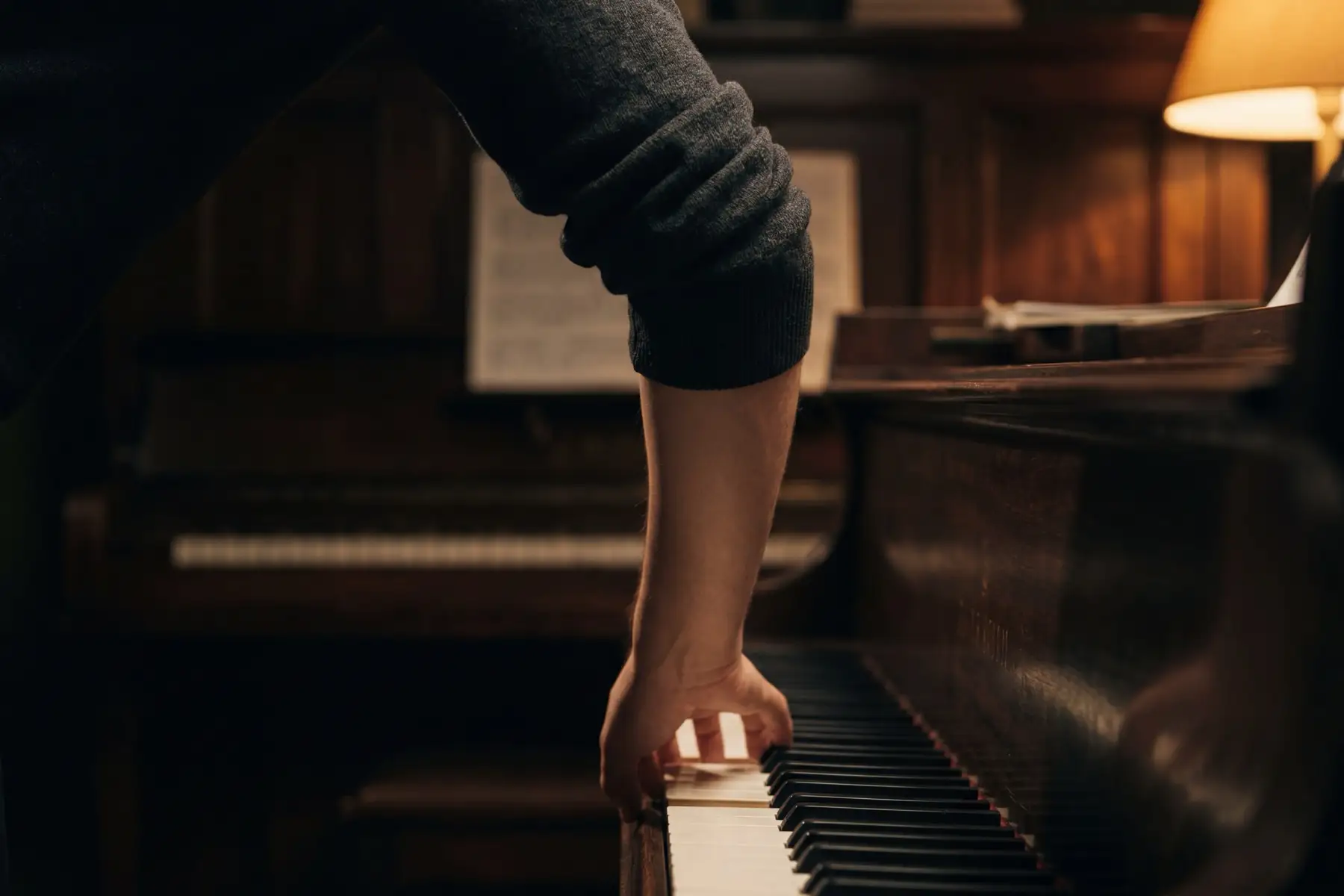
There is a moment most pianists reach where the fingers are working hard, the notes are mostly there, and the playing still feels effortful — tense in a way that does not get better with more practice. Usually the missing piece is not finger strength. It is that the arm is not yet part of the movement.
The vertical arm movement is the first arm motion to understand, and in many cases the one that changes the most. It is a subtle up–down motion led by the forearm: a small drop into the first note of a group, then a smooth rise from the forearm that prepares the next group. It is not large, and once it is working it is barely visible. But it is what lets separate finger actions become one connected musical gesture.
Why Finger Motion Alone Caps Your Control
When the fingers do all the work and the arm stays out of it, playing tends to become vertical in the wrong sense — finger-only, and often tense, mechanical, and disconnected between notes. This is not a moral failing of the fingers. It is a coordination problem: the fingers are being asked to generate, time, and connect everything by themselves, and that is more than finger motion alone can do well over a long line.
You can usually hear it before you can see it. The notes are present but the line does not breathe; longer passages tire out and start to sound mechanical roughly where the finger effort runs out. Adding more finger effort does not fix this, because the missing element was never finger effort in the first place. What is missing is an arm that drops, supports, and rises in rhythm with the music — giving the fingers something to receive instead of something to manufacture alone.
What the Vertical Arm Movement Actually Is
The motion has two parts, and they belong together.
The drop is a small descent of the forearm into the first note of a group. The arm delivers weight; the fingers, kept concentrated, receive it and let it reach the key. The fingers are not passive — they are actively organised and stable — but they are not trying to create the sound on their own.
The rise is a smooth upward motion from the forearm after the group. This is the part most players leave out, and it is the part that does the quiet work. Lifting the arm takes weight out of the keys, which softens the end of a group almost on its own. At the top of the rise you are already positioned for the next drop. So the rise is not an extra motion added on — it is preparation, happening while the previous notes are still sounding.
Done well, the whole thing is one small wave: drop → support → rise → next drop. It is rhythmic and calm, and as it settles into your playing the movement can become smaller without losing any of its effect.
What This Gives the Fingers
The point of the arm movement is not the arm. It is what the coordinated movement gives the fingers: support, timing, and freedom.
Support, because the weight that produces the tone comes through the arm rather than being squeezed out of isolated fingers. Timing, because the drop arrives with the music instead of being chased after it. Freedom, because fingers that are receiving and guiding arm weight — rather than generating force on their own — stay far more available and far less tired over a long passage.
The vertical arm movement is the foundation of the coordinated system where arm, wrist, and fingers work together — it is the first component of that system, the one the others build on. It is also the path that carries arm weight into the key as tone: without a vertical motion delivering it, there is no clean channel for the weight to travel.
When the Wrist Takes Over
There is one common way this goes wrong. The wrist starts to lead — bouncing, lifting, or driving the motion itself — and the vertical arm movement quietly disappears.
A good wrist here is free and following. It moves because the arm moves; it is part of the larger arm motion, never an independent engine and never locked. When the wrist starts initiating the up-and-down itself, it absorbs the energy that should have travelled from the arm to the key, and clarity and connection both drop off.
The fix is not to hold the wrist still — a stiff wrist is its own problem — but to let the forearm lead again so the wrist has something to follow. This is the same forearm-leads, wrist-responds coordination that runs through all of the arm work: the arm initiates, the wrist follows freely.
Try This
Choose a simple two- or four-note group.
- Drop the forearm into the first note.
- Let the forearm rise smoothly through the rest of the group, as preparation.
- At the top of the rise, notice you are already ready to drop into the next group.
Begin with a slightly exaggerated motion so you can feel each part clearly. Then make it smaller, until it is calm, small, and natural. Throughout, keep the fingers concentrated so they can receive the weight, and let the wrist follow without blocking or taking over.
Practising it slowly is where it becomes reliable — the same reason slow tempo is where movement gets grooved before it can hold up at speed.
Where This Is Built Step by Step
This is the most fundamental arm movement in the Super Fingers approach. Horizontal arm movement comes next, for wider patterns and accompaniment textures — but the vertical arm movement is the first one to understand and the one most other coordination depends on.
Inside the Piano Fantasy Academy this is developed gradually — from simple exercises to real music — so the arm motion becomes part of how you play, rather than something you produce only when you concentrate on it.
You can keep refining this on your own, or follow a clear path that builds the coordination behind it, step by step.