A note can feel heavy and stuck, or it can feel light and controlled — and the difference is almost never where players look for it. It is not in the wrist. It is in what happens at the very bottom of the key, in a place most pianists pass through thousands of times a day without ever using on purpose.
What "the bottom of the key" actually is — and why most players never reach it on purpose
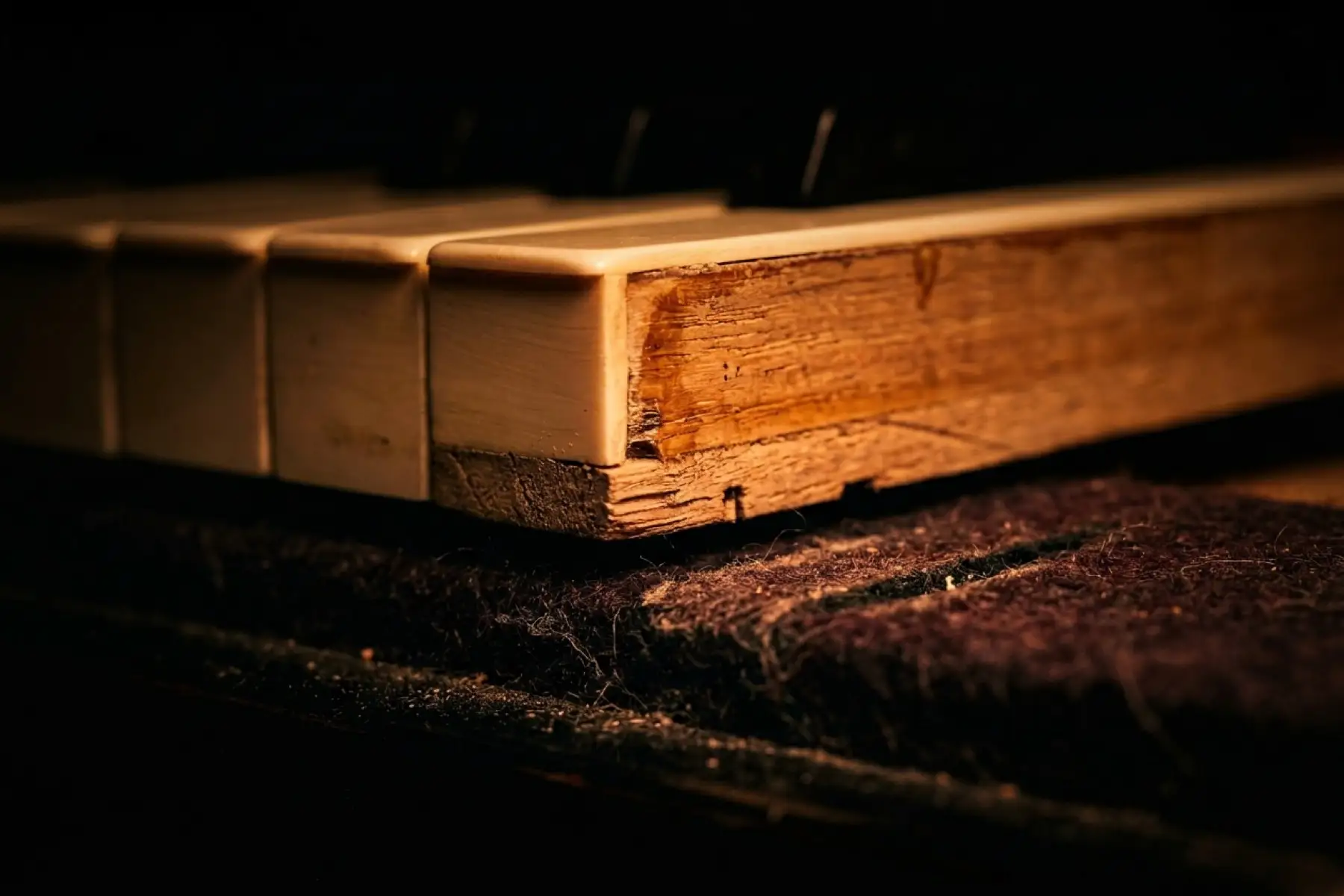
Every key has a floor. When you press a key down, it travels a short distance and then stops — it has reached the bottom of its travel, the keypad. That stopping point is not a dead end. It is a surface, and a surface is something you can play against.
Most players never use it that way. They play to the bottom of the key — the note sounds, the key has gone down, the job feels done. What they don't do is arrive at the bottom with stability and then do something deliberate from there.
That missing step is the whole subject. The bottom of the key is not where the note ends; with the right contact it is where control begins, because a stable arrival at the keypad gives you something solid to work from — and that is a matter of being shown the step exists, not a matter of stronger hands.
The coordination: drop, receive, release
Here is what reaching the bottom of the key with control actually involves, in order.
The arm drops into the key — a controlled descent driven by weight, not a finger push. The finger receives that weight. This is the part that fails most often: the finger has to be concentrated — curved and structurally engaged — so that it transmits the arm's weight into the key instead of collapsing under it. A collapsed, spaghetti finger absorbs the weight and nothing solid ever arrives at the bottom.
With a concentrated finger, the full weight of the arm arrives at the keypad through a stable structure. Then, from that stable contact at the bottom, the finger releases upward. And throughout, the wrist stays free and responsive — it follows the forearm, it does not initiate the motion and it does not bounce independently as its own agent.
That sequence — drop → contact → release → return — is what creates elasticity. And the order matters: if the wrist initiates instead of following, the contact becomes shallow; if the finger collapses, the energy disappears into the finger; if the arm never truly arrives at the bottom, there is nothing solid to release from in the first place.
Why it behaves like a trampoline
The useful image here is a trampoline, and it is useful because it carries the actual mechanism, not just a picture. You do not get height from a trampoline by being limp on it, and you do not get height by landing rigid. You get height by meeting the surface with structure — pushing into it with something that can both receive and return energy.
The bottom of the key works the same way. Too loose — a collapsed finger — and the energy is absorbed and nothing comes back. Too rigid — a locked wrist or a gripped hand — and the energy is blocked before it can cycle. The elastic result lives in between: a concentrated finger and a free wrist meeting the keypad with structure, so the contact can return energy instead of swallowing it. Elastic structure is what creates lift — at the piano exactly as on the trampoline.
Practise the cycle, not the speed
Choose one note and play it with finger 3:
- Drop the arm into the key and feel the moment the arm's weight presses the bottom — actually feel the keypad arrive, don't rush past it.
- From that stable contact, let the finger release upward, as if bouncing off the key bottom.
- Keep the wrist free — it follows the arm; it does not bounce on its own.
- Let gravity bring the arm back down for the next drop.
- Feel the whole cycle: drop → contact → release → return, slowly, until the elastic structure is something you can feel rather than something you are reasoning about.
This is preparation before the note in its most physical form — the control is set up in how you arrive and leave, not patched in afterward. The same drop-into-stable-contact is where arm weight resolves into actual tone, and the free, following wrist that lets the weight reach the keypad is the naturally low, supple wrist that improves tone and control — the bottom of the key is where those two principles meet a real surface.
Controlling the keypad this way is also a foundational lever of the whole sound-production approach worked through Kabalevsky's Lullaby, where tone is built from how the key is met, not from how hard it is hit.
One precise boundary, because it is the easiest thing to confuse this with. This post is about key-bed and tone control — playing into the bottom of the key, the drop-contact-release coordination. It is not about clear repeated notes: the rapid-repeat technique, with its finger-change on a single key, is its own distinct subject and is owned entirely by playing like a cat — the technique for clear repeated notes.
Same neighbourhood, two different jobs: this post owns how the key is met and controlled; that one owns repeated-note clarity via finger-change.
The bottom of the key, then, is not the end of the note. It is a working surface — and once you arrive there with a concentrated finger and a free wrist, it gives you control you simply do not have if you only ever play to it. That is not a matter of pressing harder. It is a matter of better instruction about a place your fingers already visit every time you play.