Almost everyone who plays a staccato note is thinking about the wrong end of it. The attention goes to the attack — how the note starts, how sharply it is struck. The note begins, it is short, that feels like the whole job. But the part of a staccato note that actually decides whether the next one is any good is not the attack at all. It is the release.
The misconception: that staccato is made by the attack
It is an understandable mistake. A staccato note is short and pointed, so it feels like a note that is made at its start — strike it cleanly, and the shortness takes care of itself. Players drill the attack, sharpen the attack, and wonder why a staccato passage still feels heavy and late by the third bar.
Here is what is actually happening. A staccato note has two ends: the moment it sounds, and the moment the finger lets the key go. If the attack is clean but the finger then stays trapped in the key a fraction too long, the hand has not regained its freedom — and the next note begins from a hand that is still stuck.
The problem you hear in bar three was created in bar one, at the release nobody was paying attention to. Staccato is not made at the attack. It is made at the moment of letting go — and that is a matter of being shown where to put the attention, not a matter of a faster hand.
What a clear release actually does
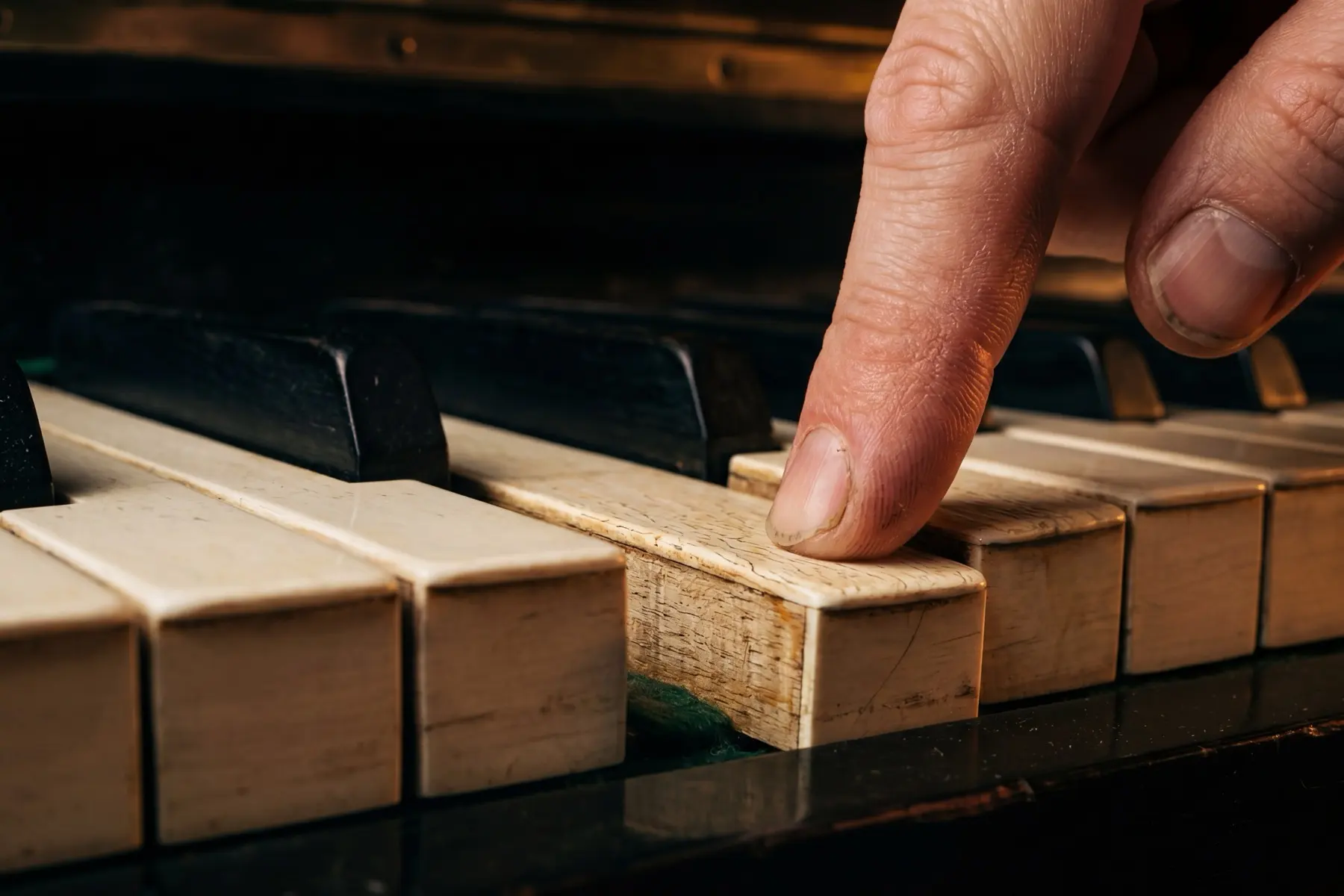
Think of the cycle of a single short note in order: the hand drops, there is stable contact at the bottom of the key, the finger releases, the arm floats slightly up again, and from there the next note can begin. Drop → contact → release → next drop. The release is the hinge of that whole cycle, and it does two things at once.
First, it ends the note cleanly — that is the obvious part. But second, and this is the part that matters, the release is already preparing the next movement. A clear, light release returns the hand to a free position, and from a free position the next note can be dropped into easily and on time.
A late, clinging release leaves the hand stiff: the arm tightens, the timing falls behind, the movement loses its momentum, and every following note inherits the problem. The release is not the end of one note. It is the beginning of being ready for the next — which is why a passage's freedom is decided here and not at the attack.
The release is the exhale of the technique
This is a brief, deliberate return to freedom between active moments — what I call a reset, the exhale of technique. You cannot only breathe in. A staccato passage that only attacks and never clearly releases is a passage holding its breath, and it stiffens for exactly that reason.
Practise the release, slowly, until it leads
Play five notes going up — not fast — with fingers 1, 2, 3, 4, 5. For each one:
- Drop the hand into the key.
- Feel the stable contact at the bottom.
- Let the finger release clearly upward.
- Allow the arm to float slightly up again.
Do it slowly enough that you can actually feel the release as its own event and not just the by-product of the attack. Let it feel clear, light, and calm.
Then repeat the cycle several times and notice the thing that proves the point: the clearer the release becomes, the easier the next drop feels. That is not a coincidence and it is not a reward for tidiness — it is the mechanism. The release was already preparing the next movement; a better release is literally a better preparation of the note after it.
It is worth being precise about where this post sits among its siblings, because they are easy to merge and shouldn't be. This post is the release mechanic — what happens in the instant of letting go, and why it governs the next note. Related:
- your short notes may all feel the same — they shouldn't — the wider question of how many different short notes there are: the full palette of arm, key-rebound, finger concentration and hand form that makes one short note round and another pointed. That post maps the whole spectrum; this one zooms into the release where staccato quality actually lives.
- staccato or pizzicato — which one are you playing — the two named touch identities you might be choosing between in the first place. This post is the release mechanic underneath whichever of those two you choose.
- the finger-timing connection that true legato is made of — the exact inverse skill: legato is precise timing of when the key is kept; staccato release is precise timing of when the key is let go. Same control, opposite intent.
- the forward motion that prepares the next movement while the current note is still resolving — in both, the release is the start of it; the way you leave a note is already the way you arrive at the next one.
In staccato, then, the release is not an afterthought to the attack. It is where the note's quality lives and where the next note's freedom is decided. A clear release makes the next note possible; a clinging one makes it late. Learning that is not a matter of a sharper attack or a faster hand. It is a matter of better instruction about which end of the note you should have been listening to.