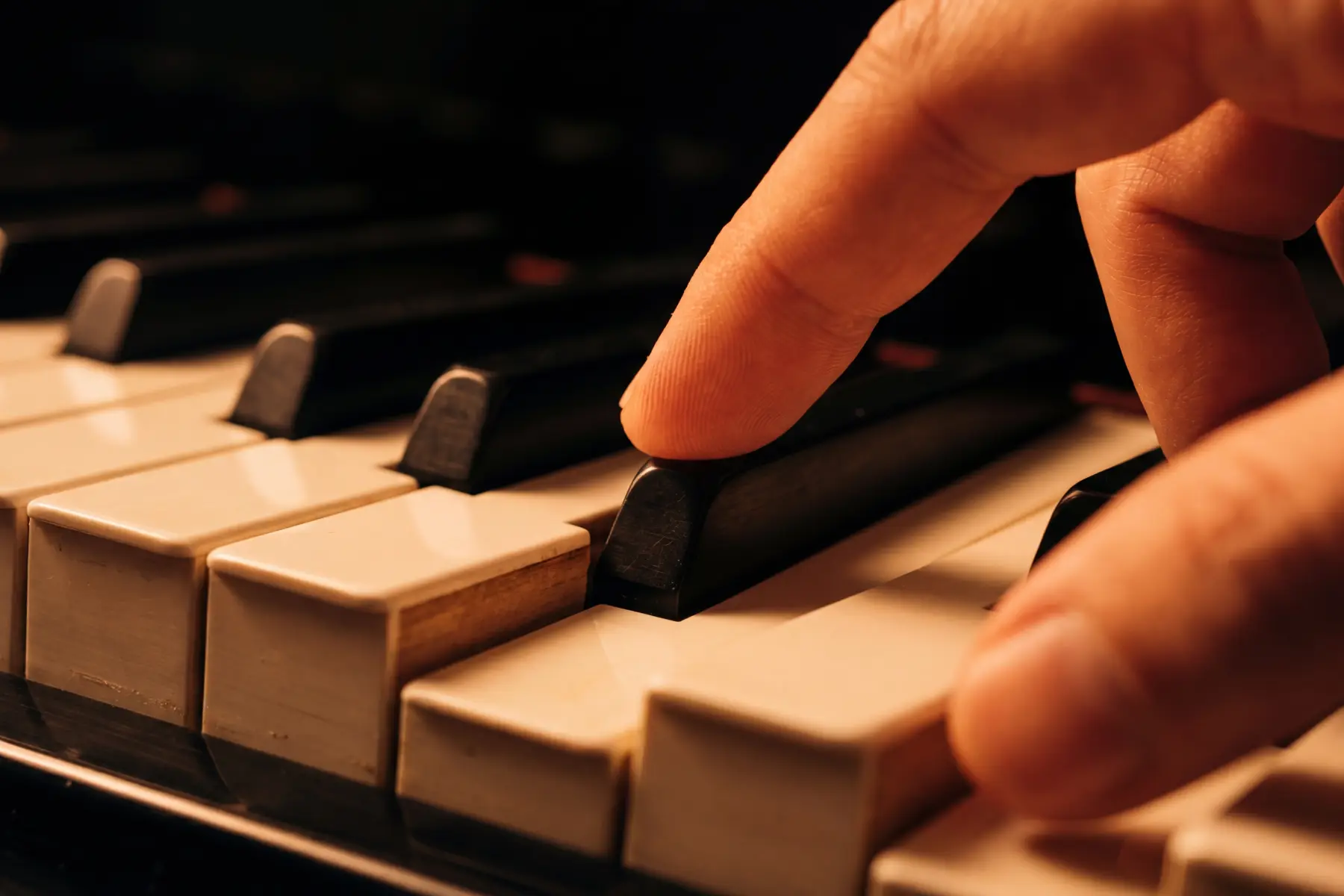
Black keys feel harder than they really are, and that gap — between how hard they feel and how hard they actually are — is the whole subject. Close the gap and the difficulty mostly disappears. It was rarely a difficulty of strength to begin with.
The reason is geometry, not weak fingers
When a black key gets missed or grabbed awkwardly, the instinct is to blame the finger: it was too weak, not trained enough, not independent enough. That is almost never what happened. The finger was usually fine. The hand was simply in the wrong place for it.
Black keys sit higher, and further into the keyboard, than white keys. If the hand stays in a white-key position — shallow, near the keyboard's edge — then when a black key arrives, the finger has to reach for it at the last moment. That last-moment reach is the miss. Not a weak finger: a finger sent on a long stretch from a position it should already have left.
The problem is the keyboard's geometry meeting a hand that was not repositioned for it — and that is a matter of being shown where the hand belongs, not a matter of finger strength you do not have.
That same geometry — the black key sitting further in, and higher — is also what makes a whole key signature comfortable or awkward under the hand. It is a different question from playing one black key cleanly, and it runs on the same fact: why Chopin taught scales in B major.
The hand has to arrive further in — and the arm takes it there
The fix is usually simple, and it is not "stretch harder." The hand must arrive slightly further in on the keyboard before the black key is played — at the depth where the black keys actually live, not at the white-key edge.
The part that matters most is what moves the hand there. It is the arm that leads this repositioning — the arm brings the whole hand to the correct depth — not a lateral stretch of the finger reaching across. This is the distinction that quietly decides everything: a finger-led reach leaves the hand behind and arrives tense; an arm-led repositioning brings the hand with it and arrives organised. Same notes, completely different security.
Very often — though not always — black keys also ask for slightly flatter fingers. The qualifier matters and is not a hedge: it depends on the passage and the sound. Where flatter does apply, the broader contact between the cushion of the fingertip and the narrower black-key surface gives a little more grip and a more secure touch.
This is the same finger-shape-as-a-choice idea that runs through all of technique — a slightly flatter or more curved finger is a decision the sound asks for, not a fixed rule, and the black-key terrain is one place it shows up clearly.
A correct position arrived at late misses exactly like no position at all
There is a second half to this that is easy to miss, because the first half — where the hand has to be — is so clearly the answer that it hides the rest of the question. Knowing the hand must arrive further in is only half of it. The other half is when it arrives there. The repositioning is not only a matter of position; it is a matter of timing, and the timing is the part that actually decides whether the black key is clean.
Here is the distinction stated plainly. The arm should lead the hand to black-key depth early — while the preceding white-key notes are still being played, not at the instant the black key is needed. The hand should already be at the right depth before the black key arrives, so that when it arrives there is nothing left to do but play it. That is the whole mechanism: the move is finished before the note, not on it.
And this is the part worth being exact about, because it changes how you practise it. A repositioning that is geometrically perfect but late produces the same miss as no repositioning at all. If the hand arrives at exactly the right depth but arrives there a fraction too late — at the moment the black key is needed rather than before it — the finger is still being sent on a last-moment reach, and a last-moment reach is the miss whether the destination was right or wrong.
Lateness, not position, is the final cause. Geometry tells you where the hand belongs; timing tells you when it has to be there. Only the early arrival — the arm taking the hand to depth while the previous notes still sound — turns a correct position into a reliable one. This is the same preparation-before-the-note principle that runs through all of technique, met here on the specific terrain of the black keys: the work is done before the note, or it is not really done.
Feel the difference between the two positions
Take a simple black-key pattern — for example E–F♯–G♯–A.
- First, deliberately place the hand as if you were still playing only white keys: shallow, near the edge. Notice how the fingers immediately feel more stretched and less secure. That feeling is the miss waiting to happen.
- Now let the arm move the hand slightly further into the keyboard, to the depth the black keys actually sit at. Let the fingers adjust naturally — often a little flatter on the black keys, sometimes not.
- Play the pattern again, slowly.
You will usually feel it at once: the notes become calmer, cleaner, and easier to trust — not because the fingers got stronger in the last thirty seconds, but because the hand is finally in the place the keys required all along.
This is the same kind of map the hand internalises through slow practice, where the right depth and position are grooved until they stop being a conscious thought, and it sits inside the larger principle that the hand should be organised before the note, not scrambling to it — the open, ready default hand shape is what makes finding the black keys reliable rather than lucky.
It is also a close cousin of why jumps miss: a missed jump and a missed black key are the same failure of arriving late and at the wrong place — different keys, identical cause.
A black key, then, is not a harder note that needs a stronger finger. It is an ordinary note that needs the hand to be in the right place at the right depth before it arrives. That is a small change, and it changes a lot — and it is not a matter of working harder. It is a matter of getting better instruction.