How to choose a good piano fingering?
How to choose a good piano fingering? To most amateurs, choosing piano fingerings seems to be the main problem they are dealing with. Yet, it is so much more complex than that. In this blog, you are going to learn a more in-depth approach to fingering in piano playing.
The first problem we encounter is that many scores don't have fingerings printed for all passages, and often much worse: Awful piano fingering!
I prefer scores that don't suggest piano fingering at all, a "clean" score. Often, it is better to come up with your own fingerings or your teacher's fingerings. But how to choose a piano fingering? And what makes a masterful piano fingering, and why so?
There are two grounds to consider in choosing a good piano fingering. The first aspect to reflect on is piano-mechanical reasons. And the second aspect is all about musical interpretation. So, we need to balance the two by asking the right questions in every situation.
Piano Technical considerations:
- Size and shape of your hands; no two hands are exactly the same.
- Each finger has a slight different function and thus its own strength and weakness.
- Rhythm and accentuations.
- Pianistic articulation; leggiero, staccato, legato, portato.
- The choice of arm movements has a direct consequence on the selection of fingering.
- Finger dexterity of each individual finger at a given moment in your pianistic development.
- Your experience and purpose of learning this piano piece.
Musical considerations:
- Musical articulation; how each note connects with the previous and following notes.
- Phrasing; where does the note come from, and where does it lead?
- The character and color of sound that you want to achieve.
- The character and color of sound that you want to create.
- The rhythmical and lyrical character of a passage.
- The tempo you decide that the final speed should be.
Dilemma: Many of the musical and pianistic considerations overlap.
For example; the arm movements we choose are strongly interconnected with the phrasing of a passage. Therefore it can call for a different piano fingering.
Another; finishing a passage softly is easier to do with any finger other than the thumb. On the other hand, giving a heavy accent is more effortless with the thumb or with 2 fingers combined on one key.
Likewise, a different tempo may require adjustments in piano fingering.
The same principle applies to technique more broadly: start from the music — read what the passage is asking, and let it point you to the technique it needs.
Let's explore how different considerations affect the piano fingering?
The size and shape of your hands are to be taken into account; no two hands are exactly the same. A particular fingering can cause too much stretching in small hands, and you can't do it. It seems simple and straightforward, but it not always is. While we advance, we want to "stretch" our limits, so we grow as pianists.
A reason that most like to keep a secret, still sometimes unavoidable, is the limitation of one's finger dexterity. Every stage of development brings new possibilities, and not to forget that new possibilities carry new responsibilities. Take that challenging piano fingering if it makes your music come out more convincingly. NEVER AVOID FINGER WORKOUTS to speed up your pianistic development and thus your means to express music.
We know that Vladimir Horowitz (read here how Horowitz approached fingerings) was always trying out new fingerings that would sound better. It is important to be curious and try even if it isn't comfortable at first.
We shouldn't always be easy on ourselves and take the challenge to try, at least for a while, some fingering that makes good sense for achieving a specific result. It might feel difficult in the beginning, but we must try. Suppose it doesn't go with a certain confidence after some serious work. In that case, you can always return to the simpler variant... and yeah, so often you'll find that easier variant even simpler than before...
In this example of the beginning of Liszt's second Ballade, I play this chromatic passage using ALL fingers switching from 1 on the note C to 5 on C♯. When executed right, this fingering results in a very frightening effect; a dark pianissimo atmosphere.
It isn't the easiest fingering to come up with, and it took me some time to get it smooth. But after many exercises, smooth arm movement, and the correct form of the hand.
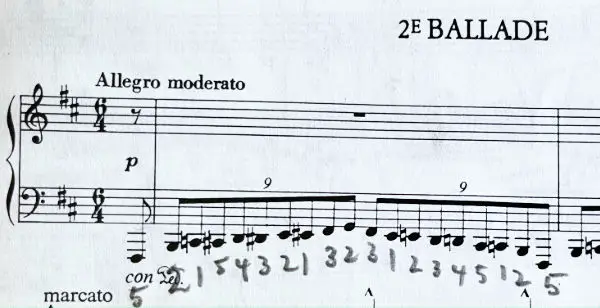
It sounds like no other fingering can achieve!
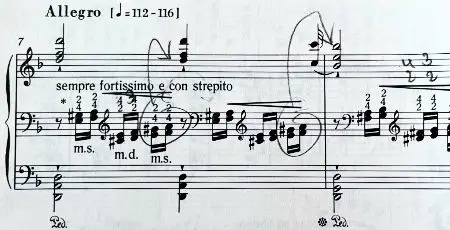
Another Liszt example is from the transcendental etude Mazeppa. Here Liszt himself indicated 4-2 for each third, which is harder to do in this fast tempo than 1-3/2-4. I use this fingering but change 2-4 here and there with 2-3 so that 3 goes over 4.
This creates a bit more flexibility, in my opinion. Liszt's idea of this fingering is to make each third sound very brilliant and "super-articulated," and it is definitely worth the extra effort.
Articulation of the notes
Articulation, how each note stands out from the other notes, is both a technical consideration and a musical decision. We need to ask how much clarity we like to hear. Just as we saw in the previous example of Liszt's Mazeppa.
A simple example is repeating notes on the same key. We can play them with alternating fingers on one note (1-2-3-4), as we do in Liszt's 'Der Totentanz' or (3-2-1-3-2-1) in Scarlatti's sonata in d-moll K141, both wonderfully performed by Martha Argerich. To execute the notes fast and clear on the same key, we need to change fingers.
We can use the same finger to repeat very rapid notes. Like at the beginning of 'Scarbo' of Maurice Ravel played with both 2-3 together continuously on the same key so that the key doesn't entirely come up. This is because alternating fingers on one key gives more articulation, and the tempo is almost "limitless". Using one finger (or two together) on the same key when playing repeating notes gives a more sustained sound. It is excellent for pianissimo playing, creating a more vibrating tone.
Phrasing of the music
Another musical consideration for how to choose a good piano fingering is phrasing — good fingering already shapes the phrase. What comes before a note, and where does it lead? Do we finish a phrase or sub-phrase in diminuendo or crescendo? Selecting an arm movement that improves a particular phrasing may require a special piano fingering that enhances the arm movement.
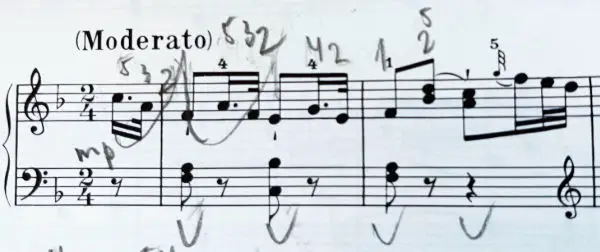
In this example of Haydn's F-dur sonata, we see short phrases of 3 notes. To ensure a smooth execution and finish the phrase with a light detached note, avoiding accents, I play this with an upward arm movement. On the third note, I don't play with the thumb but with the 2nd finger. The piano fingering, in combination with the arm movement, results in a precise execution without much effort.
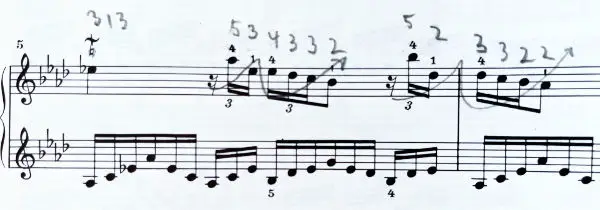
Here we have another example out of the Haydn F-dur sonata, in this example from the 2nd movement Adagio. Here the fingering is mainly chosen because of how the fingering enhances the sound quality of these beautiful, subtle melodic passages.
The character is "poco espressivo" with a "free" sound. The arm movement goes hand in hand with the fingering; a slight up action on the first two notes, followed by an upward motion towards the eighth note at the end of each small phrase. Gliding from D♭ to C in the first phrase, a quasi-gliding from B♭ to A♭ with the help of a smooth arm movement.
Expression and sound color
The color of sound is one of the most important motives for choosing fingerings at the piano. Chopin was perhaps the first pianist to talk about the different characters of each finger and the importance of this when deciding on a good fingering. Rachmaninov taught his students precisely that. I have a copy of the complete Scriabin preludes opus 11 with Rachmaninov's fingerings.
I was fortunate to get a copy of this score from Jean-Marie Cottet during a lecture he gave on fingering. He studied with Gina Bachauer. Bachauer was Rachmaninov's pupil and learned all these Scriabin opus 11 preludes with him. Those piano fingerings are unconventional, using a lot of consecutive thumbs in fast passages to emphasize those notes.
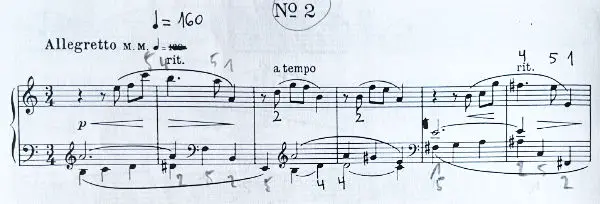
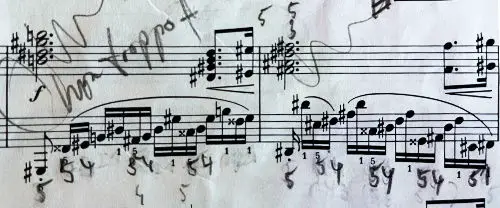
The 4th and 5th fingers are naturally weaker and thinner, therefore easier to achieve specific sounds. However, that doesn't mean that the thumb isn't able to play a beautiful pianissimo, or the 5th finger can't play a colossal fortissimo. I broke most strings, and there were plenty that I snapped in my student years, with my 5th finger in the right hand! And often, they must exactly do that!
In this example of Chopin's "Revolution etude," we see how the weak fingers 5 & 4 need to play vigorously and brilliantly. I tried to avoid it by using 5-3 instead of 5-4, but it didn't sound as good as 5-4. The key to making this passage succeed is a very fixed form of the hand. Being creative in choosing piano fingering and arm movements will hugely increase your musical color palette.
Octave playing - Legato or Non-legato
Octaves are very interesting in piano technique. They are very frequent in both melodic lines that are doubled in octaves and in virtuosic passages. They require good fingering and supple arm movements. Since the stretch in the hands when using 1-4 and even more so 1-3 in playing octaves increases, it is essential to use smooth arm movements and keep the wrists as loose as possible.
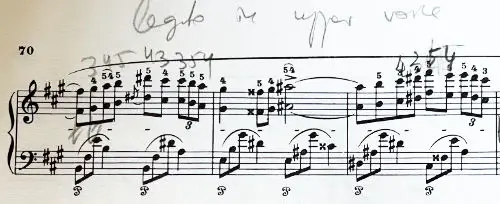
In this example from Chopin's Nocturne Opus 48 no. 2, we see the main melody doubled in octaves, as we often see when the expression intensifies. But the upper voice must be played "molto legato," meaning that the note must be held down until the following note is pressed. To achieve this, I use a lot 3-4-5 in the upper voice where 3 and 4 often cross the 5th finger.
This, combined with a good arm movement, works very well. The thumbs also need a lot of flexibility and more vertical thumbs when playing close to the black keys. There is a stretch, but we must find the right muscles in the lower arm, and then the stretch gets comfortable.
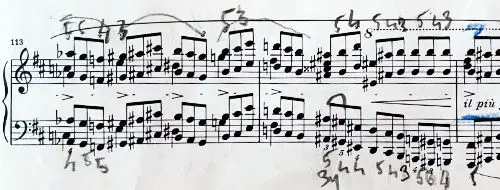
When we look at Chopin's octave etude opus 25 no. 10, we see that Chopin writes "legato" at the very beginning of the etude. Of course, some composers weren't so accurate in writing pianistic instructions. Yet, in the case of Chopin, we need to take them very seriously.
Chopin was very exact in writing what he wanted. He understood the pianistic implication of what he indicates more than any other. Also, in this etude, we need to use 5-4-3 in the outer voices of both hands to realize this legato.
When learning this etude or any other octave passage, I make many outer voices exercises alone and special exercises for flexible thumbs. Don't be afraid for a little stretching and stretch from the lower arm with free wrists.
Conclusion & Advice
Remember that each situation is different and requires a different approach to choosing a good piano fingering, depending on your experience, musical intentions, pianistic intentions, hand shape, etc. But also know that being creative and experimental makes you a much more skilled pianist. So experiment, yet be aware of your intention.
When you find a fingering that serves your purposes best, WRITE IT DOWN. Perhaps later, you may come up with a more 'sophisticated' fingering, then again write it out. However, be consistent and aware of the fingering you use. Just randomly changing fingerings causes you to make mistakes and results in an insecure performance. However, the more experienced you are, the easier it is to change a fingering quickly.
The best piano fingering is not always the one of least effort.
Trying out complex piano fingering can increase your technical skills a lot. It is good to pick fingerings sometimes just for practice purposes and change them later on. Thus, you can work on strengthening specific fingers, making them also faster and more flexible.
Read the article: Master Method 3 Steps to Superfast Fingers.
Do this in technical etudes or even difficult passages in repertoire pieces. But only if you have enough time for it, meaning you don't need to perform it any time soon.
5 Steps towards Masterful Piano Fingering
First Version Fingering
Read the music very precise and decide your first version of piano fingering. Use all information you have for making an intelligent choice. Experiment with different fingerings. *Then, take up the challenge and do plenty of first phase exercises!*
Program the Fingers
Start to work with these fingerings. As practice improves, you start to feel the music better, both pianistically and musically. *You can change the piano fingering where needed. Don't forget to write these down.*
Experiment with Alternative Fingering
As you progress and start to more and more play the piece, experiment with different fingerings in places to improve articulation and tone quality. *A new piano fingering can make a huge difference.* Remember that sometimes it is a matter of *lots of practice to make it work*.
Choose a Fingering to Stick With
Eventually, *stick with precise piano fingering* and master them thoroughly as not to mess up in a performance. Play fast and feel the weak places and practise these slow. Then try fast again. When under stress, *we rely on a solid muscle memory* even more.
Keep Perfecting
Play the piece many times through as a whole. Difficult passages, you can still go over these slowly from time to time. *Be aware, don't change piano fingerings too close to a performance.*