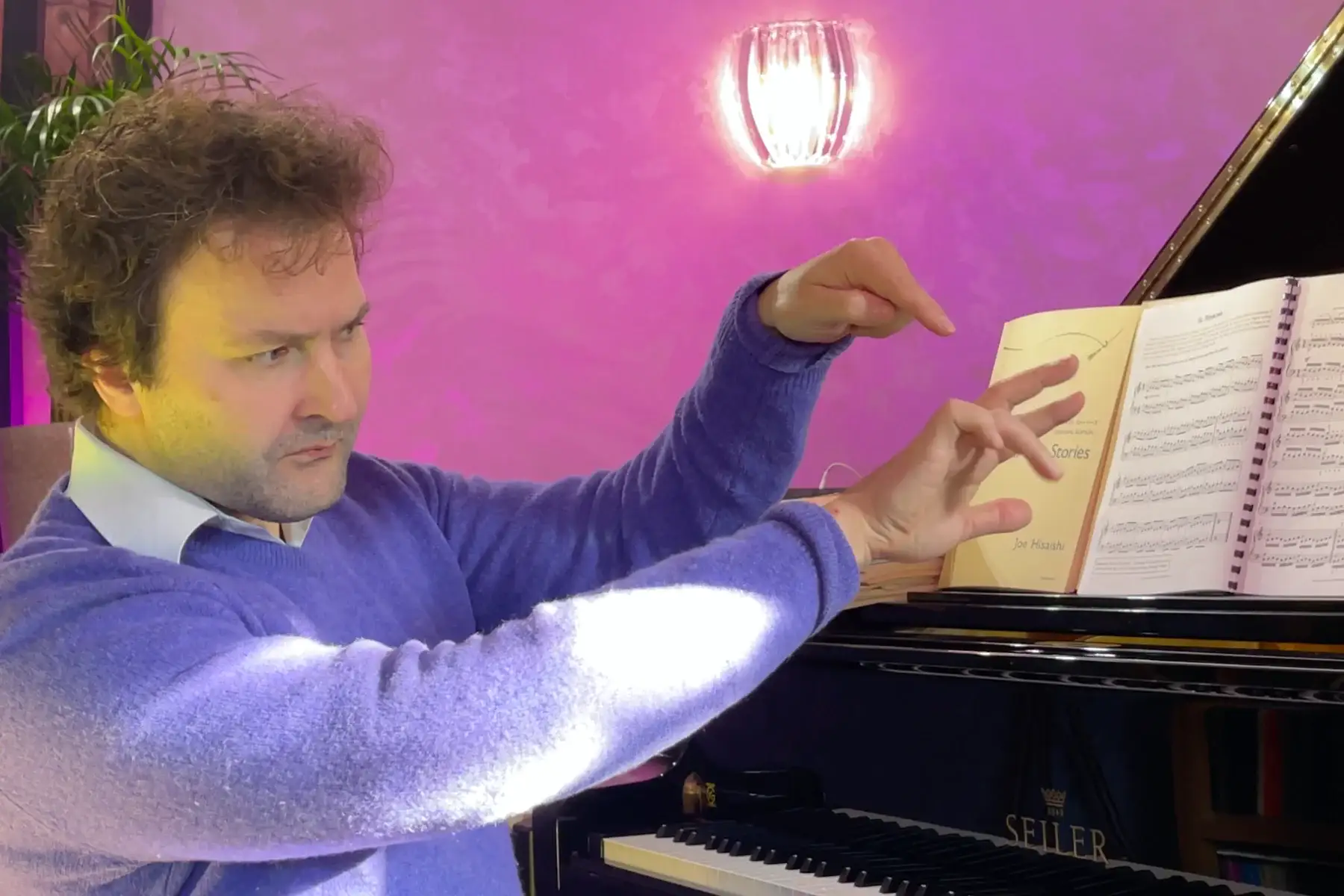
This video is all about training the fourth and the fifth finger. These are the weakest fingers of your hands, particularly number four. That's because of the anatomy in the hand — it's locked between three and five. Therefore, lifting the fourth finger is far more difficult than lifting any other finger. But still with exercises we can make it more independent.
I love to use my fourth finger and my fifth finger because I developed them well. Every finger has its own character, but the better you develop your fingers, the more rich your piano playing will get.
For developing real strong, flexible, independent fingers, I recommend Brahms exercises. These are the best exercises I have found from any exercises, including the exercises of Franz Liszt — they are far not so good as the ones of Brahms. But they are quite difficult.
Then we have the exercises I developed myself — called Super Fingers. Book one is for beginners to intermediates. There will be a part two, a part three, and a part four of transcendental difficulty. But there is a system in them, and I explain very clearly how I use the fingers, how I use the arm, and I even write the arm movements for the different exercises.
Hanon exercises are very good for developing equal piano playing — that all the notes are nicely equal in passage works — but they are not particularly designed for making real strong, flexible, independent fingers. For that, go to Brahms. Or if you want something easier, go to my book Super Fingers.
The fourth and fifth fingers are not weak. They are under-trained. This distinction matters because "weak" implies a fixed condition, and the fourth and fifth fingers are not fixed — they respond to targeted work like any other muscle group.
The anatomical reality is that the fourth finger is locked between the third and fifth by the tendon structure of the hand. Lifting it independently is harder than lifting any other finger. That is biology, not destiny. With the right exercises, the fourth finger can develop genuine independence, speed, and strength. The fifth finger is often underused for a different reason: players default to the stronger fingers and let the outside fingers stay passive. That habit compounds into real weakness over time.
Every finger has its own character. The better you develop all of them, the richer your piano playing becomes.
Here are 19 exercises across three systems — Hanon, Brahms, and Super Fingers — that specifically target 4th and 5th finger development. Building finger stability is the structural context these exercises work within. Before you start, it helps to understand why the fingers have to be freed before they can be strengthened.
From Hanon
Hanon is not specifically designed for 4th and 5th finger isolation — it is more designed for developing equality in passage work, especially useful when practised in different tonalities. But within the Hanon set, a few exercises stand out for their 4th and 5th finger demand.
No. 11. The repetition pattern here places consistent demand on the outer fingers going up. Also worth doing in different tonalities, which changes where the 4th and 5th fingers land relative to the black keys.
No. 30. Similar to No. 11 in structure. Going up favors 4th and 5th in the left hand; going down, the right hand. The combination of both is good balanced work.
No. 12. Direction-dependent: going up is 4th and 5th for the left hand; going down for the right. Use both directions deliberately.
No. 16. The stretch here is slightly larger. Going up and back — notice which direction is harder for each hand and target that one.
No. 17. My favorite of the Hanon exercises for this purpose, because of the stretching involved. The stretch activates the lower-arm muscles in a way that plain passage work does not.
These five Hanon exercises are not the main event — they are the warm-up and the entry point. For real finger independence and strength, the serious work is in Brahms. If you want printable exercises to start from, they are in the free PDF library.
From Brahms — 51 Exercises
The Brahms exercises are the best I have found for finger development — better than Liszt's exercises, in my experience. They are more demanding than Hanon and require more attention to technique, but the gains are significantly larger. All Brahms exercises are marked ben legato — real legato, meaning the key is only released when the next finger has already pressed the next key. This ben legato requirement is what makes the exercises effective.
No. 13. Ben legato, steady tempo. The 4th and 5th fingers must carry legato without the usual support from the stronger fingers. Feel it in the lower arm.
No. 18. Specifically for 4th and 5th finger trills — two against three, four against six simultaneously. First with a sustained note, then the trill figure. Very demanding. Feel the lower arm working throughout.
No. 23. Sustained thumb with 4th and 5th finger thirds. Practise in dotted rhythm first — a little pressure and release on each note. You should feel the stretch and activation in the lower arm. The muscles should work; the wrist must stay free.
No. 22. Thumb stays sustained. Sustained thumb with 4th and 5th figure working over it. You will feel the stretching; make sure you feel it in the lower arm, not in the wrist or the knuckle joints. This is the distinction between training the right muscles and risking injury.
No. 28. Chromatic scales with 4th and 5th fingers, with sustained thumb, in opposite directions. Good for training the fingers in positions that are slightly awkward — exactly the positions that appear in real repertoire.
No. 30. Trill exercise for 4th and 5th, followed by legato in 3rd to 1st. Pure finger independence work. You should feel this in the small muscles of the hand as well as the lower arm.
No. 34C. In B major — Brahms chose this key deliberately. The particular tonality changes where the 4th and 5th fingers land on the keyboard and requires constant micro-adjustment. The tonality is part of the exercise, not incidental.
All Brahms exercises are in different tonalities. The tonality in which you have to learn each exercise multiplies the effect — you cannot rely on familiar hand positions; the fingers must adapt every time. How high fingers should lift during these exercises matters as much as the notes themselves.
From Super Fingers
My own exercise system starts from scratch and builds to advanced, with explanations of both finger technique and arm movements at every stage. If you are advanced but never learned arm technique properly, Super Fingers Book 1 is still the right starting point — the arm movements written into the score are what make the exercises work at higher levels.
No. 16. Forte legato throughout, with accent on the fourth finger. A little arm involvement. The whole point of this exercise is to give an accent on the fourth finger — which is the exact motion it needs to develop independence. You can make a variation: play the same figure but with a different accent assignment.
No. 20. Going up is for right-hand 4th and 5th; going down is for left-hand 4th and 5th. All legato. Repeat in different tonalities.
No. 47. Sustained fifth finger going up; sustained thumb going down. Very good for the fourth finger specifically — it must work alongside the sustained note rather than around it.
No. 48. Fourth finger sustained. Then the fingers return, second finger stays. This is the same sustained-note principle from a different angle — the sustained finger is always the one that needs to develop independence, because it cannot help its neighbor while it is holding.
No. 52. Also No. 51 — the latter is more pizzicato in character, good for 4th and 5th articulation specifically.
Work through these exercises systematically. Do not try to do all nineteen in one session — select four or five and work them carefully, then rotate. Feel the lower arm working throughout. When you feel tired, it should be in the lower arm — not in the wrist, which must stay free throughout. Fatigue in the wrist means you are tensing in the wrong place. Reset, free the wrist, and continue.
The anchor finger principle is directly connected to the sustained-note exercises here — the sustained finger becomes an anchor, which is what those exercises are training. And once the 4th and 5th fingers start to develop real strength, the technique system behind fast fingers gives the broader framework for how they integrate into full-hand technique.