How to supercharge your fingers and speed them up in a slow tempo — that is what this is about. To learn fast fingers in a slow tempo is very well possible, and I learned that from my teacher Avi Schönfeld, who learned it again from his teachers like Ilona Vincze and Yvonne Lefébure and then Arthur Rubinstein.
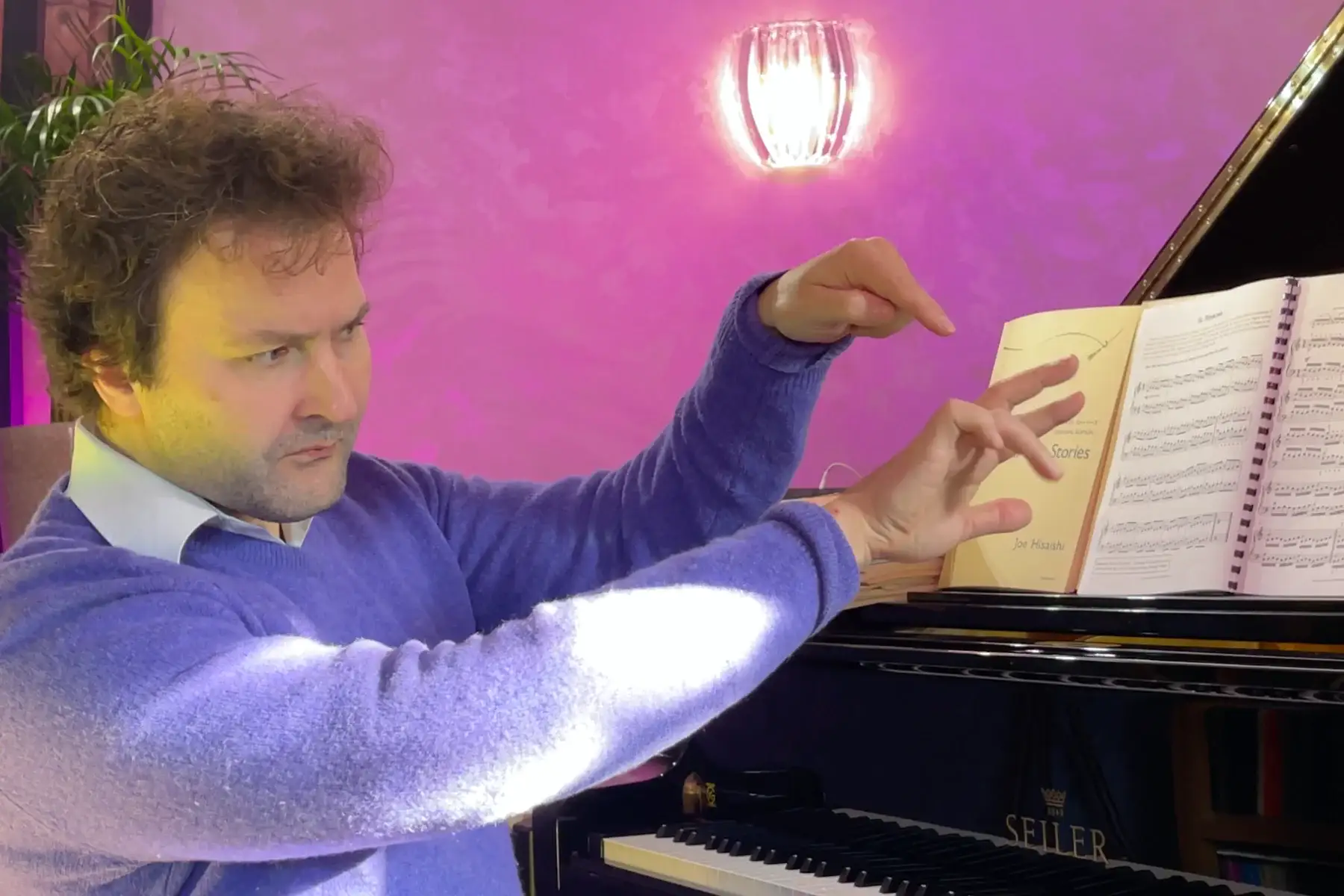
He referred to it as the umbrella technique. The umbrella technique is: you open your hand to have your fingers in a prepared position to play the notes they have to play, but at the same time we can strike the key fast. By doing that we actually train finger speed while we play from note to note in a slow tempo. We still use very active fingers. And then when we play the next note, the moment that note presses the key, the other finger goes up in a fast position back to the prepared position.
Like that we develop very good finger independence, strength, and flexibility — because by lifting the fingers you make the skin between your fingers more flexible, so you get a better stretch.
What you have to pay attention to: we have to concentrate the fingers well enough. Not spaghetti fingers. Our fingers need a resistance — so they can push the key. The key has a weight, about 70g depending on where on the keyboard. In order to manipulate that key and the sound, we need concentration in the fingers.
When we concentrate fingers, the wrist is always free of tension. Many students when they concentrate the fingers make the wrist tight. But the wrist must always be free and the fingers concentrated. For me I don't have to think about it — my wrist is always free, my fingers are always in a certain level concentrated, and my arm is always looking for the right movements to smooth out every passage.
Someone told me that in the early days when Vladimir Ashkenazy was still young, a concert-goer heard him practising just before a concert — and what he was actually doing is play through fast passages very slowly, lifting the fingers like that, to really free the fingers, to really prepare and make the fingers ready for good articulation. This is a very good way to prepare yourself and be in good shape.
The idea that fast playing requires fast practice is one of the most persistent misconceptions at the piano. The truth is the opposite: speed is trained slowly. You develop it in the muscles during slow work, and it becomes available in performance because it is already programmed — not because you practised it fast and hoped it would smooth out.
This is the logic behind the umbrella technique, which I learned from my teacher Avi Schönfeld. He learned it from his teachers — Ilona Vincze, Yvonne Lefébure, Arthur Rubinstein. It has been the working method of great pianists for a very long time, and for good reason.
Here are ten ways to apply slow practice so that it actually builds speed.
1 — The Umbrella Technique: Fast Attack, Slow Tempo
The foundation of everything that follows — and written out in my e-book, Super Fingers. Open your hand so the fingers are in a prepared position over the keys they will play. Then strike the key with a fast, decisive attack. Fast and speedy. After the key goes down, the finger lifts immediately back to the prepared position — the other fingers waiting, open like an umbrella.
The tempo is slow. The finger movement is fast. This is the distinction that makes the technique work. You train finger speed without training passage speed. The muscles learn a quick, decisive strike; the slow tempo gives you time to execute it correctly.
Hands separate first. Always. Feel the muscles in the lower arm — those are the real motor of the fingers, not the small muscles you can see in the hand. When you activate those lower-arm muscles correctly, you also develop a natural stretch in the skin between the fingers, increasing flexibility without any risky forced stretching.
Why slow practice builds speed goes deeper into why this mechanism works the way it does.
2 — The Sustained Notes Exercise
While playing a passage or exercise, keep one finger sustained on its key. The held finger becomes an anchor point. The others must move independently around it.
This is exercise 48 in my book Super Fingers. The thumb stays down while the other fingers do the work. Then you reverse it — one of the weaker fingers (4th or 5th) stays, and the thumb works around it. This is when you discover which fingers have genuine independence and which are still borrowing from their neighbors.
Always let the arm weight hold the sustained key — you only need about 70g, which is easily much more than the arm's resting weight. The sustained finger must not press, grip, or tense. And the wrist must stay free throughout.
The umbrella hand position is the framework this exercise lives within.
3 — Work in Improvising Mode
When practising passages, do not run through them mechanically. Improvise around them. Feel what you are doing. Try to feel it in the muscles, mold the shape of the hand according to the situation on the keys, and notice where the weak points are.
I search for the articulation. I search for freeing my fingers. What I am doing at this stage is freeing the fingers — making them strong, flexible, and fast, and independent, all at the same time.
When you feel the weak spots, you work on them more. When you feel something working, you know why. This attentiveness is what makes slow practice useful rather than merely dutiful.
4 — Equality First, Speed Later
All notes must be equally strong. There will be notes that are weaker than others — work on it until they are not anymore.
Make sure the thumbs do not give accent. The thumb is naturally strong; it tends to dominate. Train it to give a little less so all fingers are equally strong. Not equally soft — in this phase, we practise strong.
When you want to learn to play soft, which is more difficult than strong, you first need strong fingers. The stronger the fingers, the easier it becomes to play soft, in combination with flexible arm movements.
5 — Weak Hand First
For most people, the left hand is the weaker of the two. Start with the left. This is not a small matter of discipline — it shapes what gets developed first, and the weaker hand needs more time than the strong hand, not less.
Practise the left hand until it feels solid. Then the right. Then both hands together, which is a second phase: once you add the other hand, you begin to think about arm movements and coordination, which changes the nature of the work.
6 — Relaxation Between Notes
Between each note, there is a small relaxation in the muscles. Each note is isolated from the next. When you feel tired during practice, it is almost always from tightening the wrist or the arm — not from lifting the fingers. Lifting the fingers is normal; it is like striking a ball: prepare, strike, prepare, strike. From the preparation you take energy; when you strike, you release it.
Never fight the fatigue signal by pushing through. Fatigue from tightening is a warning. Stop, reset the wrist, let the arm settle, and begin again.
7 — Apply the Umbrella to Actual Passages
This technique is not only for exercises. Apply it to the hard passages in your pieces. Take Fantasie-Impromptu by Chopin — if I was going to work on that passage again, I would do this kind of slow umbrella work on it. Lift the fingers, prepare, feel the stretch in the muscles, articulate.
When you eventually play faster and are closer to the keys, the fingers still lift and articulate — just less. The technique is the same at all speeds. The only thing that changes is the amplitude of the movement. The underlying mechanic — fast attack, prepared position, discrete relaxation between notes — stays.
Vladimir Ashkenazy reportedly practised his fast passages this way before concerts: slowly, with exaggerated lifting, to re-establish clean articulation and preparation before going on stage. It is not just for learners. It is a maintenance method for the highest level of playing.
8 — Build In Segments
Do not run through a whole exercise from beginning to end. Work in segments. Four notes, six notes.
Once a segment is solid, extend it. Once it is extended, connect. Practising Hanon with intent works exactly this way — each exercise is a segment-by-segment accumulation, not a single long run.
The risk of always playing from beginning to end is that you over-practise the opening and under-practise everything that follows. Always starting from the beginning is a way of never reaching the end with any reliability.
9 — Use Different Tonalities
Once an exercise feels natural in one key, move to another. Different keys require the hand to adapt — the position shifts slightly, the hand passes over the thumb at a different moment, the stretch between adjacent notes changes.
This adaptation — the slight recalibration of hand position for each new key — is itself a form of technique. It trains the hand to be flexible rather than locked into one shape. A hand that only knows C major does not have flexible technique; it has a habit. The technique system behind fast fingers covers why this kind of adaptability is what makes speed transferable across repertoire.
10 — Concentrated Fingers, Free Wrist
This is not the tenth method; it is the underlying condition that all nine methods depend on.
More concentrated fingers give a more crystalline, clear, crisp sound. Softer fingers with a good combination of arm movements and arm weight give a more sonorous, warm sound. You play with that. Every passage, every note, needs its own individual sound color.
But as a technique, you always need to be aware of the concentration — because when fingers concentrate, the wrist is always free. The wrist must be free. The arm is not completely passive — it moves — but the wrist itself is free.
Many students, when they concentrate the fingers, make the wrist tight. I ask them to loosen the wrist and suddenly the fingers become spaghetti. But when you hold a pen, the wrist is free — it is not tight. Piano playing should not be different.
It is, in the end, more psychology than anatomy. Most students have to learn first to think in a different way, and then walk on it until it becomes second nature.
The secret thread of legato applies the same concentrated-fingers-free-wrist principle to connected playing. And once the umbrella technique is embedded, the next step is to apply it systematically in exercises designed specifically for that purpose — practising Hanon with intent is the natural extension.