Having difficulties to get started when practising the piano, because you feel cold or stiff in the hands? Three methods of warming up your fingers to ensure a good and pleasant practice session.
Fingers that are warmed up will take information better, they will program better, and you will learn faster. The second reason is: when you are warmed up, your piano sound will become better. The third reason is that when you're warmed up, the chance of injury is reduced.
The three ways add up — they don't replace each other. So the first way might be sufficient, maybe you need to add step two and step three. Depending on the shape you are in, you might need all three of them.
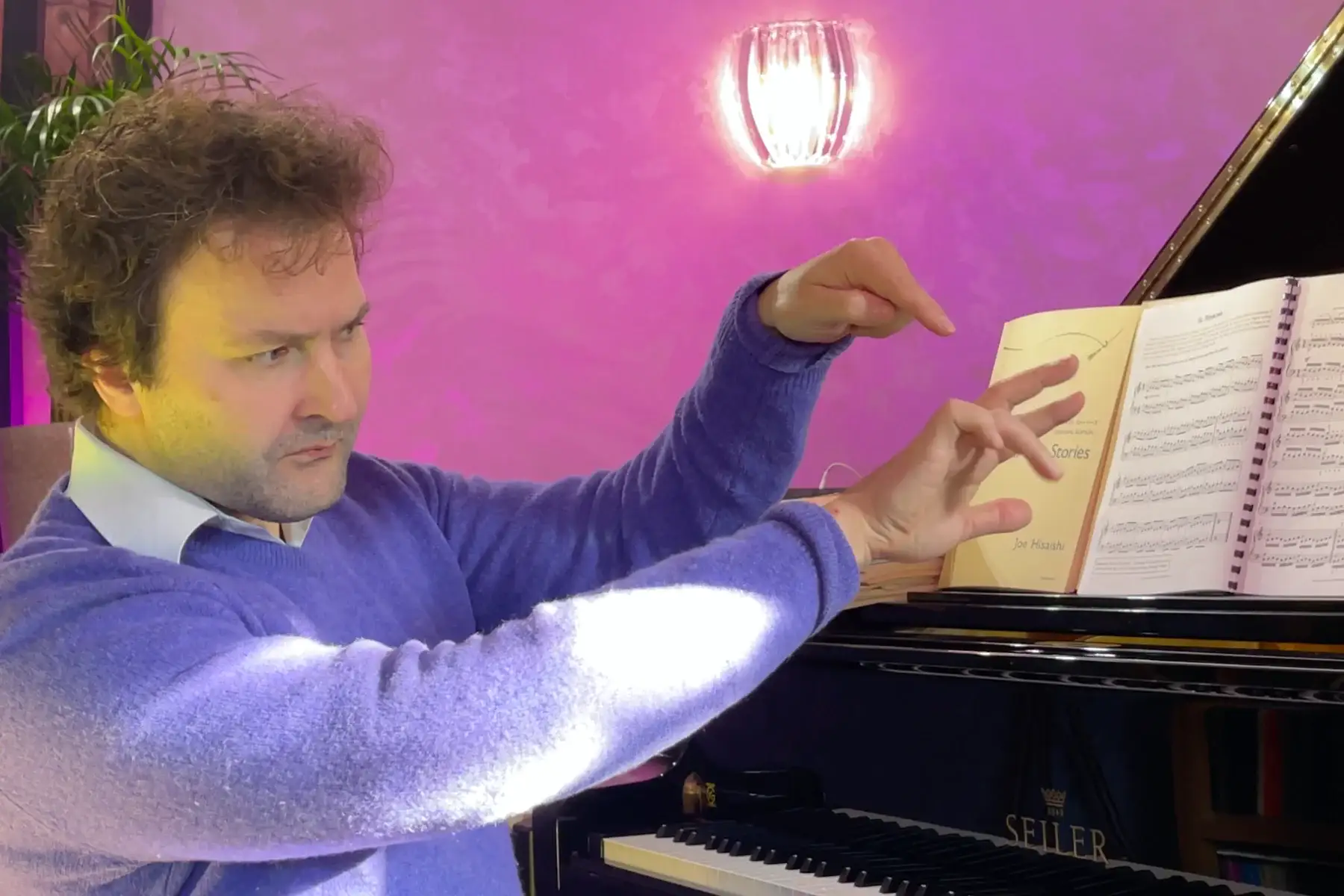
Method one: finger exercises. Play in the first phase, hands separate, so that you can focus on the muscle group you want to warm up. The muscles here in the lower arm — here are the muscles of your fingers. Make this kind of exercises. If you're really cold, you will start to feel tiredness here in the muscles, like you're doing a fitness exercise.
Method two: stretching. Bend the hand down and you feel here a stretch. Push gently... and then stretch the arm... and you feel here a stretch in the lower arm. Keep it a little bit. And then do the opposite. That's very good. A good blood circulation in your muscles will increase your suppleness.
Another nice stretching exercise: like you're squeezing the water out of a towel. Slowly... You'll feel it here. This is also a stretching exercise they do with tennis elbow. When you have tennis elbow, this exercise is very good for that.
Method three: warm water. This is something that Glenn Gould used to do — put your arms in a hot water tap. Make sure that the lower arms are all in. Relax for five or fifteen minutes, whatever feels comfortable. And then massage the lower-arm muscles, because that's the motor of the fingers. And as Joseph Hofmann suggests in his book, take a tub of hot water and do some stretchings from the skin in hot water — make sure only the skin stretches and not the joints. You will notice that after doing this, your hands become soft and mellow.
Why Warming Up Matters
Cold or stiff fingers are not just uncomfortable — they affect what you can learn.
Warmed-up fingers take information better. They program better. You will learn faster in a warm-up session than in one where you push cold muscles into difficult passages from the first minute. The second benefit is sound: warmed-up hands produce better tone quality immediately, because the arm and wrist are supple and the fingers have their full range of articulation available. And the third benefit is the most important: warm muscles are far less susceptible to injury than cold ones.
The three methods I describe here add up — they do not replace each other. One might be enough on a normal day. On a cold day, or after time away from the instrument, you may need all three. Try them in order and stop when you feel ready. The goal is not to complete a ritual; the goal is to feel the muscles activate and the tone open up.
Building finger stability is downstream from warming up well — you cannot build on a cold, stiff foundation.
Method 1 — Finger Exercises at the Piano
This is the most important method and the one you should always use.
Play hands separately first — this is the first principle of all technique work. Separate hands let you focus entirely on the muscle group you are activating: the muscles in the lower arm, which are the real motor of the fingers. When you first begin, if you are genuinely cold, you will feel tiredness in those muscles quickly — like a light fitness exercise. That is correct. Let those muscles work, feel them activate, and rest when they ask for it.
The five exercises I use most frequently for warm-up are:
- Brahms No. 9 — broken-chord pattern. Start without rotation, just broken chords, nice legato. You feel it immediately in the hand. Once that is easy, add the rotation — but do the simpler version first. You should feel it here in the lower arm.
- Super Fingers No. 19 — sustained thumb. The thumb stays on G while the other fingers work around it. With both hands. This exercise also works the small muscles in the hand, not only the larger ones in the forearm. Very good for activating the hand quickly.
- Super Fingers No. 21 — finger combinations. Begin slowly and deliberately. The combination of stretching and finger-movement here opens up the muscles in a way that simple passage-playing does not.
- Hanon exercises with raised fingers. If the Super Fingers or Brahms exercises are too advanced, use Hanon. Play hands separately, raise the fingers actively, and use black keys — not just C major. Any Hanon exercise works; the black keys create slightly different hand-position demands that require more active engagement.
- Octave exercise with graduated stretching. Start with thumb and fifth finger (1-5) over one note, then extend the interval by one note at a time until you reach two octaves. Then work with 1-4, then chromatically (fifth finger on white keys, fourth on black). The stretch should always be felt in the lower arm — never in the wrist, which must stay free. Later, you can add 1-3. This also improves your octave technique directly. How high the fingers should lift during these exercises matters — active lifting is not optional.
Focus on the muscles you want to warm up. You do not have to use these exact exercises, but you should target the lower arm consistently. If you want printable material to work from, the free PDF library has exercises you can keep at the piano.
Method 2 — Stretching
If finger exercises alone are not enough — after several days away from the instrument, after garden work or manual labor, or when the muscles feel tight despite playing — add stretching.
Wrist and forearm stretch: Bend the hand down at the wrist and feel the stretch on the back of the lower arm. Push gently with the other hand, hold briefly, then reverse — bend the hand back and feel the stretch on the underside of the forearm. A good blood circulation in the muscles will increase suppleness and reduce the time it takes to warm up fully.
Towel-squeezing exercise: Interlace your fingers and squeeze as if wringing water from a towel — slowly, with intention. You will feel it along the lower arm and in the small hand muscles. This exercise is also used in rehabilitation for tennis elbow; it is both a warm-up and a preventive measure for the muscle groups that piano playing strains most.
Never force a stretch to the point where you feel it in the joints. If you feel it in the wrist or the knuckles, reduce the range. The target is the soft tissue of the lower arm and the skin between the fingers.
Method 3 — Warm Water
This is what Glenn Gould used to do before playing, and what Josef Hofmann recommends in his book on piano technique. It is for genuinely cold conditions — a cold studio in winter, or muscles that will not release despite exercises and stretching.
Immerse your lower arms in a hot water tap or a basin. Make sure the entire lower arm is submerged — that is where the motor lives. Relax for five to fifteen minutes, whatever feels comfortable. While in the water, gently stretch the skin between the fingers (not the joints). After removing your hands, massage the lower arm muscles actively — you are speeding up the blood circulation to the exact muscles you need.
After this, your hands will feel soft and mellow. Go directly to the piano and do some activation exercises. You will notice immediately how much more responsive the fingers are. In the Netherlands the winters are mild — this method is rarely necessary. But if you live in a genuinely cold climate, or practise in a cold room, this can make the difference between an effective session and a wasted one.
These three methods, used in order and stopped when the body feels ready, are a complete warm-up system. Exercises for weak fingers become much more effective when the hand is warm before starting them. And the principles of practising Hanon apply directly to the finger exercises in Method 1 — the same raised-finger, active-muscle approach makes warm-up work double as technique work.